
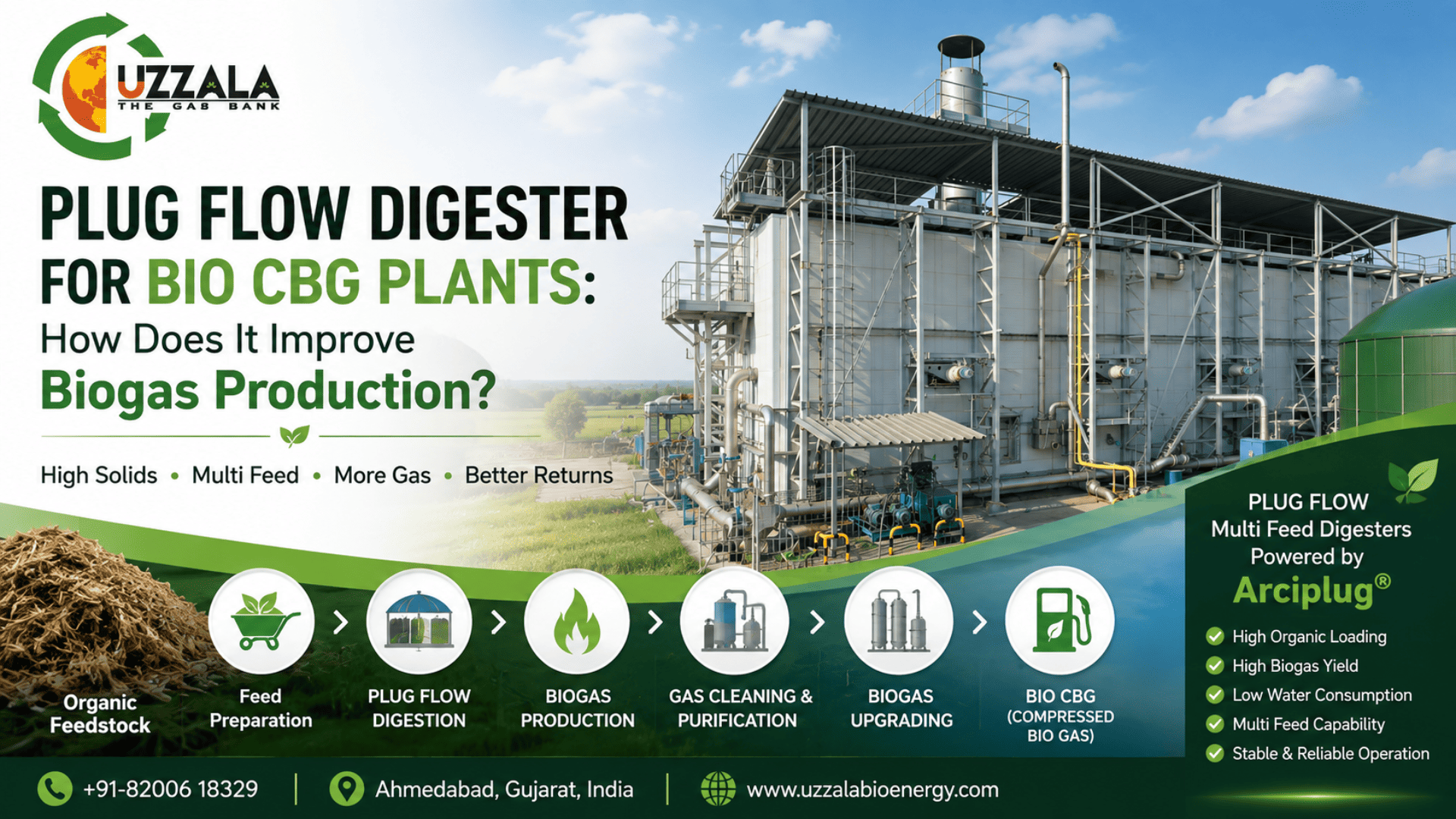
Plug Flow Digester for Bio CBG Plants: How Does It Improve Biogas Production?
India's transition toward cleaner fuels is creating new opportunities for Bio CBG (Compressed Bio Gas) production from agricultural residues, livestock waste, food waste and other biodegradable materials. As industries and project developers look for efficient anaerobic digestion technology, the choice of digester has become increasingly important for achieving reliable biogas production and long-term plant performance.
A Plug Flow Digester for Bio CBG Plants can be particularly valuable when the project involves high-solids, fibrous or variable organic feedstocks. Instead of relying on large quantities of dilution water, modern dry digestion systems are designed to process suitable feedstocks at higher solids concentrations while maintaining controlled biological conditions.
For projects requiring multi-feedstock flexibility, Uzzala Bio Energy Solutions offers PLUG FLOW Multi Feed Digesters – Powered by Arciplug®, designed around advanced plug-flow digestion principles for challenging organic materials.
What Is a PLUG FLOW Digester for Bio CBG Production?
A PLUG FLOW Digester is an anaerobic digestion reactor in which organic material progresses through the digester in a controlled forward-moving flow. As the feedstock moves through different sections, microorganisms break down the organic matter through the major stages of anaerobic digestion, ultimately producing methane-rich biogas.
Unlike conventional continuously stirred systems, a plug-flow approach can maintain a more defined progression of the biomass through the reactor. This makes the technology particularly interesting for high-solids anaerobic digestion and feedstocks such as agricultural residues, straw, manure and other suitable organic materials.
Arciplug® describes its PLUG FLOW system as a patented dry digestion technology designed for high-solids and multi-feedstock applications, including agricultural residues and municipal organic waste.
For a Bio CBG plant, the overall process can be understood as:
Organic Feedstock → Feed Preparation → PLUG FLOW Digestion → Biogas → Gas Cleaning → Biogas Upgrading → Compression → Bio CBG
The quality and consistency of biogas produced at the digestion stage directly influence the downstream gas purification and upgrading process.
Why Biogas Production Matters in a Bio CBG Plant
The primary purpose of an anaerobic digester is to convert biodegradable organic matter into biogas. This biogas generally contains methane, carbon dioxide and small quantities of other gases.
For a CBG project, the methane-rich biogas is further processed to remove unwanted components and increase methane concentration. The resulting upgraded gas can then be compressed and used as Compressed Bio Gas.
Therefore, improving the digestion stage can support the entire value chain.
A well-designed digestion system can help project developers focus on:
-
Consistent organic feedstock conversion
-
Stable biological performance
-
Efficient methane generation
-
Higher solids handling
-
Better utilization of difficult biomass
-
Reduced water dependency
-
Efficient use of available land
-
Reliable feedstock flexibility
-
Production of useful digestate
This is why the selection of the right CBG plant technology should begin with a careful evaluation of feedstock characteristics rather than looking only at the gas upgrading equipment.
How PLUG FLOW Technology Can Improve Biogas Production
1. Designed for High-Solids Feedstocks
One of the major advantages of modern dry PLUG FLOW technology is its suitability for high-solids organic materials.
Agricultural residues such as straw and other fibrous biomass can be difficult to process in systems designed primarily for dilute slurry. PLUG FLOW systems can be engineered around suitable high-solids feedstocks, reducing the requirement for extensive dilution.
Arciplug® states that its PLUG FLOW digesters can handle feedstocks with total solids levels of up to 40%, depending on the material and system design.
For Bio CBG projects, this can create an important opportunity to convert locally available biomass into renewable gas without unnecessarily adding large quantities of water.
2. Multi-Feedstock Capability
Feedstock availability can change throughout the year.
For example, a Bio CBG project may have access to:
-
Paddy straw
-
Wheat straw
-
Cow manure
-
Napier grass
-
Press mud
-
Agricultural residues
-
Food-processing waste
-
Organic municipal waste
-
Other suitable biodegradable materials
A Multi Feed Digester can provide greater flexibility when feedstock composition changes.
Arciplug®'s reference projects demonstrate the use of PLUG FLOW technology with different feedstocks, including paddy straw and cow manure in Haryana and high-solids manure in China.
This flexibility is particularly important for commercial Bio CBG Plants, where maintaining a reliable feedstock supply throughout the year can influence plant utilization.
3. Higher Organic Loading Potential
Organic Loading Rate (OLR) is an important parameter in anaerobic digestion. It indicates how much organic material is introduced into a given digester volume over a specific period.
A system capable of handling a higher organic load can potentially process more feedstock within a given reactor volume, subject to feedstock characteristics and biological operating conditions.
Arciplug® identifies its PLUG FLOW system as a high-load reactor and reports OLR capability of up to 11 kg VS/m³ under applicable conditions.
For project developers, higher loading potential can contribute to:
-
More efficient reactor utilization
-
Greater throughput
-
Better use of available land
-
Potentially smaller reactor volumes for a given throughput
-
Improved project economics when properly engineered
However, OLR should always be determined through feedstock testing, process design and biological validation rather than applying a single value to every project.
4. Reduced Dependence on Added Water
Water consumption is an important consideration for modern biogas plants.
Conventional wet digestion processes may require substantial water to achieve the desired slurry consistency. This can increase the volume of material that must be pumped, treated and ultimately handled as digestate.
Dry anaerobic digestion takes a different approach.
Where feedstock characteristics are suitable, PLUG FLOW dry digestion can process material with significantly less dilution. Arciplug® specifically highlights its ability to process suitable high-solids feedstocks without added dilution water.
This can be particularly useful for Bio CBG projects located in areas where water availability is a concern.
Lower water addition can also mean less unnecessary liquid volume moving through the plant.
5. Stable Flow and Microbial Activity
Anaerobic digestion depends on a balanced microbial ecosystem.
Hydrolysis, acidogenesis, acetogenesis and methanogenesis work together to convert complex organic matter into methane-rich biogas.
In a plug-flow configuration, biomass progresses through the reactor rather than being completely mixed throughout the entire vessel. This can support a more defined biological progression through the digestion process.
Arciplug® describes its system as maintaining axial plug stability while using controlled vertical mixing and limited recirculation to support process stability.
For a Bio CBG Plant, stable digestion is important because inconsistent biogas production can affect downstream gas purification and upgrading operations.
Why Choose Arciplug® PLUG FLOW Technology?
Uzzala Bio Energy Solutions focuses on advanced solutions for the renewable gas industry, including PLUG FLOW Multi Feed Digesters – Powered by Arciplug®.
The technology is particularly relevant to projects where feedstock characteristics, water availability and operational efficiency are major considerations.
Key reasons to consider Arciplug® PLUG FLOW technology include:
-
High-solids digestion for suitable organic feedstocks
-
Multi-feedstock capability
-
Reduced dependence on added dilution water
-
High organic loading potential
-
Compact and scalable reactor concepts
-
Application across agricultural and other challenging biomass streams
-
Potential for efficient biogas and biomethane production
-
Modular approach for different project requirements
-
Suitable for diverse climatic conditions when appropriately engineered
Arciplug® reports more than 30 PLUG FLOW digesters implemented worldwide and projects involving agricultural residues, municipal organic waste and other challenging feedstocks.
PLUG FLOW Multi Feed Digesters for Agricultural Waste
India generates significant quantities of agricultural residues every year. Much of this biomass can become a valuable resource when properly collected, prepared and processed.
Paddy straw, crop residues, manure and energy crops can potentially become feedstocks for renewable gas projects, provided their physical and chemical characteristics are appropriate for the selected digestion process.
A PLUG FLOW Multi Feed Digester can help create a pathway such as:
Agricultural Residue → Anaerobic Digestion → Biogas → Purification → Biomethane → Bio CBG
A notable Arciplug® reference project in Haryana uses paddy straw and cow manure for renewable gas production, demonstrating the application of PLUG FLOW technology to agricultural feedstocks in India.
This type of application is particularly relevant to India's growing interest in agricultural waste-to-CBG projects.
PLUG FLOW Digestion and the Circular Economy
A modern Bio CBG plant should not be viewed only as a gas-production facility.
It can become part of a broader circular economy.
Organic waste that might otherwise be burned, dumped or underutilized can be converted into:
-
Renewable biogas
-
Bio CBG or biomethane
-
Organic nutrient-rich digestate
-
Reduced waste-management burden
-
Renewable energy
-
Potential additional economic value for biomass suppliers
This approach creates a connection between waste management, renewable energy, sustainable agriculture and clean transportation fuel.
Research published in 2026 has also examined plug-flow anaerobic digestion and co-digestion of plant material with cow dung, including evaluation of both biogas production and digestate quality.
Is PLUG FLOW Technology Suitable for Every CBG Project?
Not necessarily.
The correct digester depends on the project's feedstock and operating conditions.
Before selecting a Plug Flow Digester for a Bio CBG Plant, developers should evaluate:
-
Feedstock type
-
Total solids
-
Volatile solids
-
Moisture content
-
C/N ratio
-
Fibre content
-
Particle size
-
Potential contaminants
-
Daily feed availability
-
Seasonal variations
-
Expected biogas yield
-
Required methane output
-
Available land
-
Water availability
-
Digestate management
-
Gas purification requirements
A professional feasibility study and feedstock characterization should therefore come before final technology selection.
This is particularly important when a project plans to use multiple feedstocks.
The Future of Plug Flow Digesters in India's Bio CBG Industry
The Indian renewable-gas sector is moving toward greater utilization of agricultural residues, organic waste and other locally available biomass.
At the same time, research and technology development continue to explore dry anaerobic digestion, high-solids digestion, co-digestion and plug-flow systems for different waste streams. Recent research has examined dry digestion of organic municipal solid waste and factors such as hydraulic retention time, digestate recirculation and energy performance.
India's official science and technology portal has also listed plug-flow anaerobic digestion technology for converting food waste into biogas and liquid manure, demonstrating continued interest in plug-flow concepts across different scales.
For larger commercial projects, however, the focus should remain on engineering, feedstock suitability, process stability, gas yield and lifecycle economics.
A Plug Flow Digester for Bio CBG Plants can offer an efficient approach to converting suitable high-solids organic materials into biogas. Its potential advantages include multi-feedstock flexibility, high-solids handling, reduced water dependency, efficient reactor utilization and stable biological processing.
For projects based on agricultural residues, manure, energy crops or other suitable organic feedstocks, PLUG FLOW Multi Feed Digesters – Powered by Arciplug® can provide an alternative to conventional digestion approaches.
The key is not simply producing biogas. A successful Bio CBG project must create a reliable chain from feedstock collection and digestion to gas purification, biomethane upgrading and final CBG production.
Uzzala Bio Energy Solutions can help project developers evaluate suitable technologies and develop renewable-energy solutions based on their feedstock, capacity and project requirements.
Looking for a PLUG FLOW Multi Feed Digester for your Bio CBG project?
Uzzala Bio Energy Solutions
Ahmedabad, Gujarat, India
Call: +91-82006 18329
Website: www.uzzalabioenergy.com
Explore the possibilities of converting agricultural and organic waste into renewable gas with advanced PLUG FLOW Multi Feed Digester technology.
