
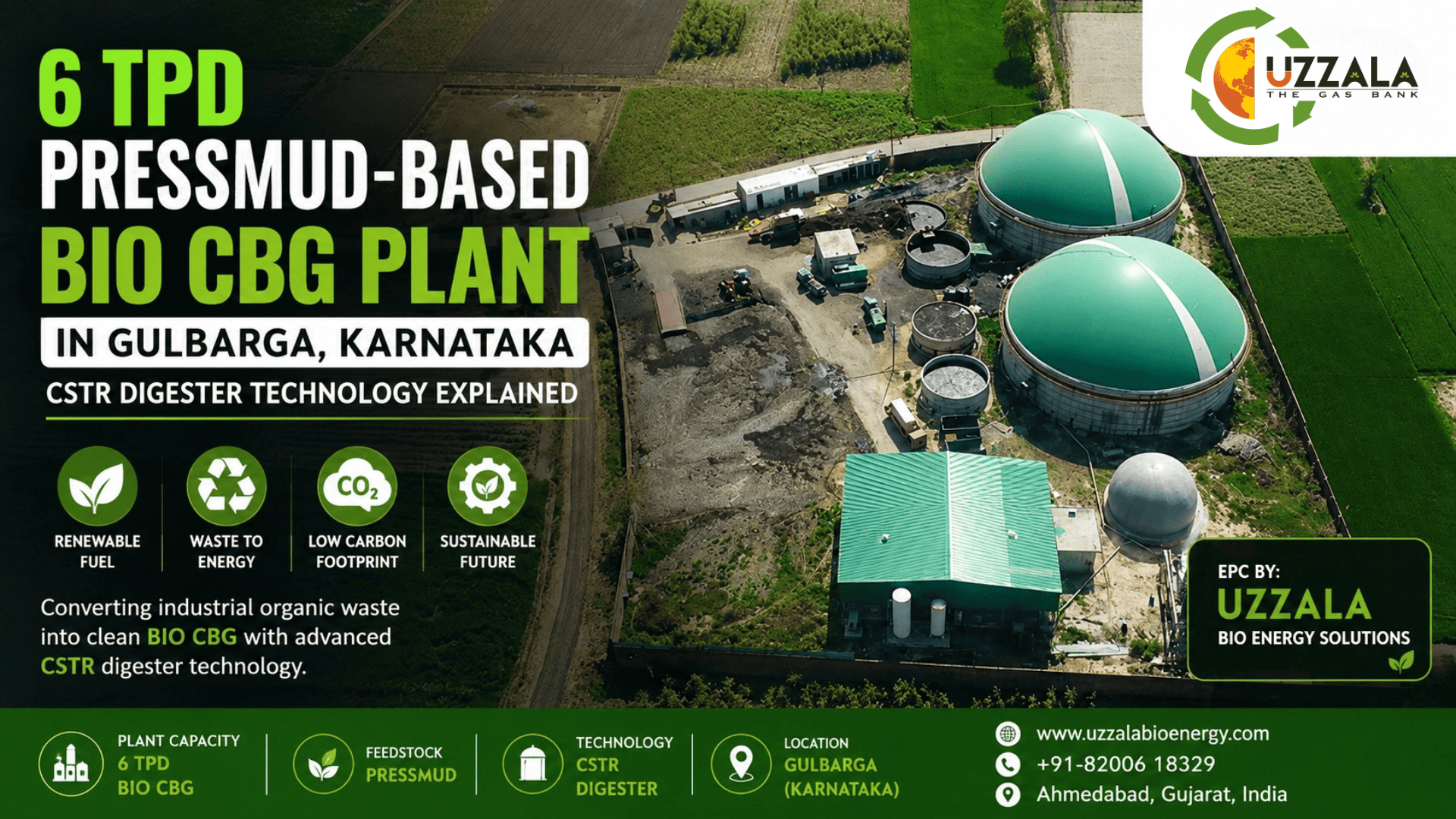
6 TPD Pressmud-Based Bio CBG Plant in Gulbarga, Karnataka: CSTR Digester Technology Explained
India is steadily moving toward cleaner and more sustainable fuel alternatives, and Bio-CBG (Compressed Bio Gas) is becoming an important part of this transition. By converting suitable organic waste and agricultural or industrial residues into renewable gas, Bio-CBG plants can support both waste management and clean-energy production.
A notable example is the 6 TPD Pressmud-Based Bio CBG Plant in Gulbarga (Kalaburagi), Karnataka, engineered and executed by Uzzala Bio Energy Solutions, Ahmedabad, for Rudraksh Bio Energy.
The project uses CSTR (Continuous Stirred Tank Reactor) Digester Technology to process pressmud as the primary feedstock. Through controlled anaerobic digestion, the organic material is converted into biogas, which can subsequently be purified and upgraded to produce Bio-CNG/Bio-CBG.
This project demonstrates how a sugar-industry by-product such as pressmud can be utilized as a valuable feedstock for renewable fuel production.
Watch the 6 TPD Bio CBG Plant in Gulbarga(Kalaburagi), Karnataka
Take a closer look at the 6 TPD Bio CBG Plant in Gulbarga, Karnataka, including the plant setup, pressmud feedstock application, and CSTR Digester Technology implemented by Uzzala Bio Energy Solutions.
Watch the project video on YouTube:
https://www.youtube.com/watch?v=5kdETATnNAo
Project Details
- Plant Capacity: 6 TPD Bio CBG
- Feedstock: Pressmud
- Technology: CSTR Digester Technology
- Project Type: Pressmud-Based Bio-CNG / Bio-CBG Plant
- Location: Gulbarga (Kalaburagi), Karnataka, India
- EPC: Uzzala Bio Energy Solutions, Ahmedabad
- Client: Rudraksh Bio Energy
The project provides a practical example of integrating organic industrial residue, anaerobic digestion and renewable fuel production into a commercial Bio-CBG system.
What Is a Pressmud-Based Bio CBG Plant?
A Pressmud-Based Bio CBG Plant is a renewable-energy facility designed to utilize pressmud as an organic feedstock for biogas production.
Pressmud is generated as a by-product of the sugar manufacturing process. Because it contains biodegradable organic matter, it can be evaluated for use in anaerobic digestion based on its physical and chemical characteristics.
Instead of considering pressmud only as an industrial residue, suitable material can be incorporated into a renewable-energy value chain.
The overall process can be represented as:
Pressmud → Feedstock Preparation → Anaerobic Digestion → Raw Biogas → Gas Cleaning → Biogas Upgrading → Biomethane → Bio-CBG
The exact plant configuration depends on feedstock characteristics, plant capacity, process requirements, site conditions, and selected technologies.
For organizations with access to suitable sugar-industry residues, Pressmud to Bio CNG can provide an opportunity to combine waste utilization with renewable fuel generation.
Understanding CSTR Digester Technology
CSTR stands for Continuous Stirred Tank Reactor. It is an anaerobic digestion technology used for suitable slurry-based and pumpable organic feedstocks.
In a CSTR system, feedstock is introduced into a controlled anaerobic environment. Mechanical or other appropriate mixing arrangements help maintain relatively consistent conditions inside the digester and improve contact between microorganisms and biodegradable material.
The anaerobic digestion process involves several biological stages:
- Hydrolysis
- Acidogenesis
- Acetogenesis
- Methanogenesis
During these stages, microorganisms break down complex organic matter and convert it into simpler compounds. Methanogenesis ultimately contributes to the formation of methane-rich biogas.
The raw biogas generated from the digester contains methane along with carbon dioxide, moisture, hydrogen sulphide and other impurities. Therefore, additional gas treatment and upgrading are required before the gas can be used as high-quality Bio-CNG/Bio-CBG.
Why CSTR Technology Is Important for Bio CBG Projects
Technology selection is one of the most important steps when developing a Bio CBG Plant.
A suitable digestion technology should be selected after considering the feedstock characteristics, solids concentration, moisture content, biodegradability, consistency, expected gas production and other technical parameters.
For suitable slurry-based feedstocks, CSTR Digester Technology provides several practical characteristics:
- Continuous feeding and discharge
- Controlled anaerobic digestion conditions
- Effective mixing of suitable feedstock
- Better contact between microorganisms and organic material
- Controlled process environment
- Suitability for appropriate slurry-based feedstocks
- Integration with downstream biogas purification systems
- Potential scalability for commercial applications
However, CSTR technology should not be selected solely because of plant capacity. Feedstock analysis and detailed project engineering are essential before finalizing the technology configuration.
How Pressmud Is Converted into Biogas
Feedstock preparation and management are critical for the performance of a Pressmud Biogas Plant.
The pressmud available from a sugar-processing facility can vary in moisture, composition and physical characteristics. Therefore, the feedstock should be evaluated before designing the complete digestion system.
Depending on project requirements, feedstock management may include:
- Pressmud collection
- Feedstock storage
- Feedstock preparation
- Slurry preparation
- Mixing
- Controlled feeding
- Process monitoring
After suitable preparation, the feedstock is introduced into the anaerobic digestion system.
Inside the CSTR digester, microorganisms operate in an oxygen-free environment and break down biodegradable organic matter. This biological process generates raw biogas.
The raw gas then moves to the gas-treatment section for further purification and upgrading.
From Raw Biogas to Bio-CNG
Producing biogas is only one part of a complete Bio CNG Plant.
Raw biogas generally needs to be conditioned and upgraded to remove unwanted components and increase methane concentration.
A typical process involves the following stages.
1. Raw Biogas Collection
Biogas generated inside the digester is collected through the plant's gas-handling system.
2. Gas Cleaning
The raw gas is treated to reduce undesirable contaminants that could affect downstream equipment and gas quality.
3. Hydrogen Sulphide Management
Hydrogen sulphide needs to be controlled because it can contribute to corrosion and operational issues.
4. Moisture Removal
Excess moisture is removed to support efficient downstream gas treatment and equipment operation.
5. Biogas Upgrading
An appropriate upgrading technology is used to reduce carbon dioxide and other unwanted components while increasing the methane concentration.
6. Compression
After upgrading and quality control, the biomethane can be compressed for suitable storage, transportation or utilization as Bio-CNG/Bio-CBG.
This integrated pathway converts organic feedstock into a renewable gaseous fuel.
Why Pressmud Is Relevant to Bio-CBG Production
The sugar industry produces various organic by-products, and finding productive applications for these materials can contribute to a more circular resource-management model.
A Pressmud-Based Bio CBG Plant creates a potential value chain:
Sugar Industry → Pressmud → Anaerobic Digestion → Biogas → Purification → Biomethane → Bio-CBG
This approach connects industrial by-product management with renewable energy production.
For projects located near sugar-processing facilities, access to pressmud can potentially provide a local feedstock source. However, factors such as availability, quality, seasonality, transportation and storage must be evaluated before project development.
Benefits of a Pressmud-Based Bio CBG Plant
A properly engineered project can offer benefits across waste management, renewable energy and resource recovery.
Renewable Fuel Production
Suitable organic feedstock can be converted into biogas and upgraded into renewable gaseous fuel.
Industrial By-Product Utilization
Pressmud can become part of a productive waste-to-energy system rather than remaining an underutilized industrial residue.
Circular Economy
The process creates a connection between the sugar industry, biomass utilization, renewable gas generation and resource recovery.
Local Feedstock Utilization
Where adequate pressmud is available, the material can potentially be utilized closer to its source, subject to project feasibility.
Renewable Energy Development
Bio-CBG and Bio-CNG projects can contribute to India's broader movement toward alternative and renewable fuels.
Another Uzzala Bio-CBG Project: Dry Digestion Technology
Uzzala Bio Energy Solutions has also been involved in projects based on different anaerobic digestion technologies.
A separate example is the Dry Digestion Technology Bio-CBG Plant at Jansath, Muzaffarnagar, Uttar Pradesh.
Unlike the Gulbarga project, which focuses on CSTR Digester Technology and pressmud feedstock, this project demonstrates the application of Dry Digestion Technology for Bio-CBG production.
Watch the Jansath Bio-CBG Project
Video: Dry Digestion Technology Bio-CBG Plant | Neeraj Kumar Singh Addresses Press | Jansath, Muzaffarnagar
YouTube Video:
https://www.youtube.com/watch?v=XlRYBHWPZfc
This second project provides an additional example of how different digestion technologies can be applied depending on feedstock characteristics, plant requirements and project objectives.
Together, the two projects demonstrate the importance of selecting an appropriate technology for each individual Bio-CBG application rather than using a single technology for every type of feedstock.
CSTR vs Dry Digestion: Why Technology Selection Matters
The Gulbarga and Jansath projects also highlight an important point for Bio-CBG project developers: digestion technology should be matched to the feedstock and project requirements.
CSTR Digestion
The Gulbarga project uses CSTR Digester Technology, which is appropriate for suitable slurry-based and pumpable feedstocks under the project's design conditions.
Key characteristics include:
- Continuous feeding
- Continuous mixing
- Controlled digestion conditions
- Suitable for appropriate slurry-based feedstocks
- Integration with biogas upgrading systems
Dry Digestion
The Jansath project demonstrates Dry Digestion Technology, which follows a different approach to handling suitable high-solids organic feedstocks.
Technology selection may depend on:
- Feedstock moisture
- Total solids
- Organic composition
- Feedstock availability
- Material handling requirements
- Gas-production expectations
- Plant capacity
- Site conditions
- Operating requirements
- Project economics
A detailed feedstock assessment and engineering study should therefore be completed before selecting the digestion technology.
Factors to Consider Before Developing a Pressmud-Based Bio CBG Plant
Organizations planning a Bio CNG Plant in Karnataka or another part of India should evaluate the complete project rather than focusing only on digester capacity.
Important factors include:
- Availability of pressmud
- Feedstock quality and consistency
- Seasonal feedstock availability
- Feedstock transportation distance
- Storage requirements
- Laboratory feedstock analysis
- Biomethane potential
- Suitable digestion technology
- Expected biogas generation
- Gas purification requirements
- Biogas upgrading technology
- Compression and storage
- Digestate management
- Utility requirements
- Site infrastructure
- Environmental and regulatory requirements
- Offtake strategy
- Capital investment
- Operating costs
- Operation and maintenance requirements
A detailed technical and commercial feasibility study can help determine the appropriate configuration for a particular project.
Why Choose Uzzala Bio Energy Solutions? | Bio CBG EPC Company
Uzzala Bio Energy Solutions, based in Ahmedabad, Gujarat, is an EPC company working in the Bio-CBG, Bio-CNG, biogas, biomethane and waste-to-energy sectors.
The company works across different stages of Bio-CBG project development, from initial project planning and technology selection to engineering, execution, installation and commissioning.
Uzzala Bio Energy Solutions provides expertise in:
- Bio-CBG Plant EPC Solutions
- Bio-CNG Plant Engineering
- Biogas Plant Design and Execution
- Feedstock-based technology planning
- CSTR Digester Technology
- Dry Digestion Technology
- Anaerobic digestion systems
- Biogas purification
- Biomethane upgrading
- Plant fabrication and installation
- Commissioning support
- Turnkey project execution
- Technical project assistance
The Gulbarga 6 TPD Pressmud-Based Bio CBG Plant demonstrates Uzzala's project execution using CSTR technology, while the Jansath Bio-CBG Project provides another example involving Dry Digestion Technology.
The Future of Pressmud to Bio-CBG
India's growing focus on Compressed Biogas, Bio-CNG, renewable natural gas, biomass utilization, waste-to-energy and circular economy solutions is creating opportunities for organic-waste-based fuel projects.
Pressmud can be particularly relevant in regions with an established sugar-industry ecosystem and sufficient feedstock availability.
However, successful Pressmud to Bio CBG projects require more than just an available feedstock. They require proper feedstock assessment, appropriate digestion technology, efficient gas treatment, reliable plant operation, suitable infrastructure and a commercially viable project model.
The 6 TPD Bio CBG Plant in Gulbarga, Karnataka demonstrates how CSTR technology can be integrated into a pressmud-based renewable fuel project.
The Jansath project further demonstrates how another digestion approach, Dry Digestion Technology, can be used for a different project configuration.
These examples highlight the importance of project-specific engineering and technology selection in the growing Bio-CBG industry.Conclusion
The 6 TPD Pressmud-Based Bio CBG Plant in Gulbarga(Kalaburagi), Karnataka is a practical example of using CSTR Digester Technology to process suitable pressmud feedstock for renewable biogas and Bio-CBG production.
The project connects sugar-industry by-product utilization with anaerobic digestion, biogas purification and renewable fuel production.
At the same time, Uzzala Bio Energy Solutions' Dry Digestion Technology Bio-CBG Plant at Jansath, Muzaffarnagar demonstrates that different feedstocks and project requirements can require different technological approaches.
For businesses, sugar-industry stakeholders, biomass suppliers, renewable-energy developers and investors exploring Bio CBG Plants, Bio CNG Plants or Pressmud to Bio CNG projects, technology selection and detailed project engineering are critical to developing an efficient solution.
Uzzala Bio Energy Solutions provides EPC and technical solutions for Bio-CBG Plants, Bio-CNG Plants, Biogas Plants, Biomethane Projects and waste-to-energy systems across India.
Project Enquiries
Company: Uzzala Bio Energy Solutions
Office: Ahmedabad, Gujarat, India
Website: www.uzzalabioenergy.com
Email: uzzalabio@gmail.com
Call: +91-82006 18329 | +91 97569 62526 | +91 98250 17181
