
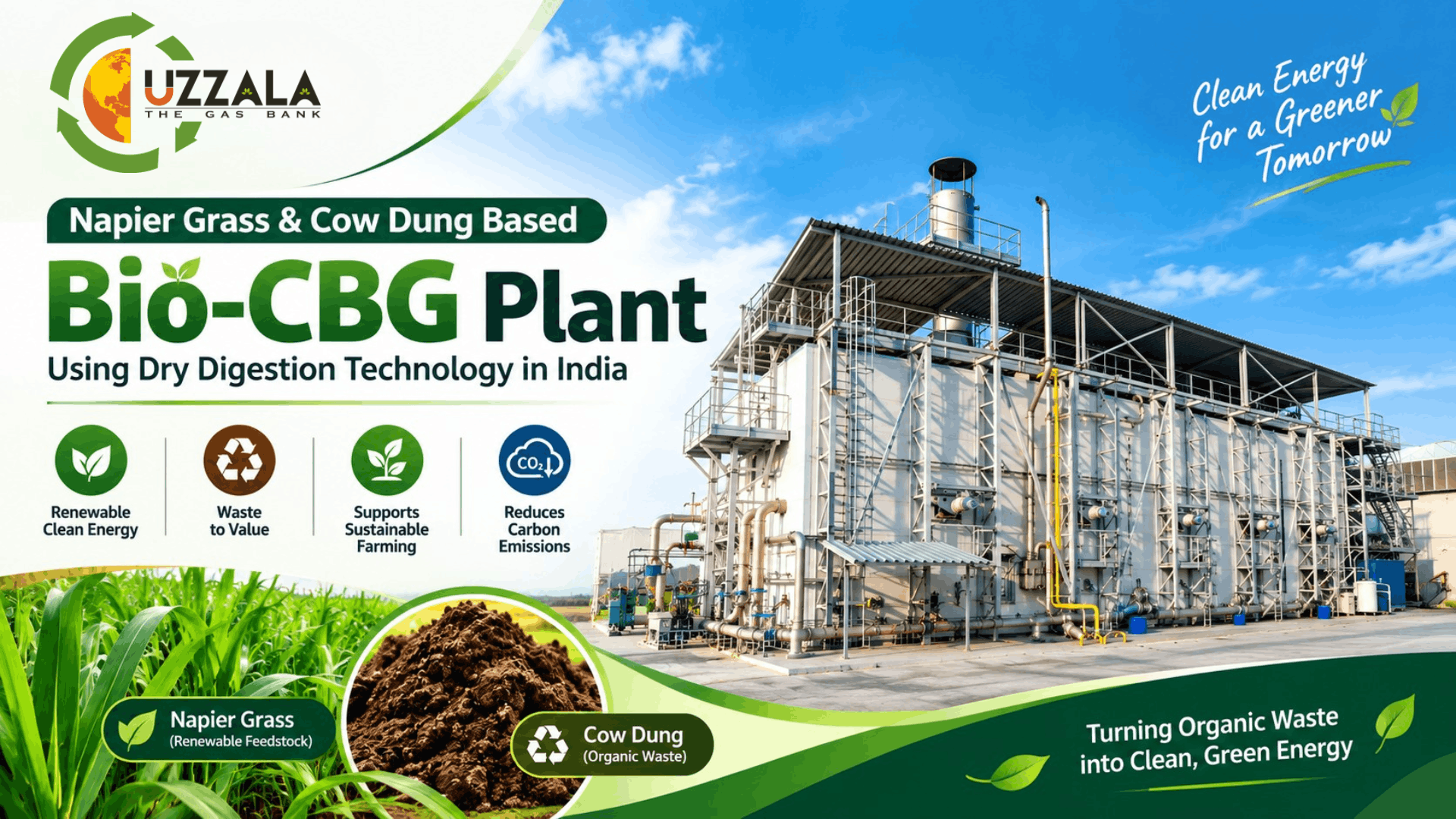
Napier Grass and Cow Dung Based Bio-CBG Plant Using Dry Digestion Technology in India
India’s renewable energy landscape is moving beyond conventional solar and wind projects toward practical waste-to-energy solutions that can convert agricultural resources, livestock waste and other organic materials into useful fuels. Among these technologies, Compressed Bio-Gas (CBG) is gaining increasing attention because it can transform biodegradable biomass into a methane-rich renewable fuel while also generating useful organic manure.
One promising approach is the use of Napier Grass and cow dung as feedstocks for Bio-CBG production. When these materials are appropriately prepared and processed through anaerobic digestion, the resulting biogas can be purified, upgraded and compressed for use as Bio-CBG.
For projects using high-solids biomass, Plug Flow Digester Technology and other dry digestion approaches can provide an alternative to conventional slurry-based digestion systems. The technology selection, however, needs to be based on feedstock characteristics, solids content, gas yield, project scale and operating conditions.
A notable example of this emerging model is the ₹75 crore green energy project at Shedubhar, Amreli, Gujarat, highlighted by Uzzala Bio Energy Solutions in its September 16, 2026 video. According to the video, the planned Bio-CNG project will use Napier Grass and cow dung as biomass feedstocks and aims to connect agriculture, animal husbandry and renewable fuel production.
https://www.youtube.com/watch?v=OVHKKBHpTNQ
What Is a Napier Grass and Cow Dung Based Bio-CBG Plant?
A Napier Grass and cow dung based Bio-CBG plant is a renewable energy facility designed to process biodegradable biomass through anaerobic digestion.
Napier Grass can serve as an energy-rich agricultural biomass feedstock, while cow dung is a commonly available organic material from livestock operations. When these materials are managed in a suitable digestion system, microorganisms break down the biodegradable matter in an oxygen-free environment and generate biogas.
The general conversion pathway can be represented as:
Napier Grass + Cow Dung → Anaerobic Digestion → Raw Biogas → Gas Purification → Biogas Upgrading → Compression → Bio-CBG
The remaining digested material can also be processed and utilized as an organic soil amendment or fertilizer product, subject to applicable quality and regulatory requirements.
This creates a broader circular model in which agricultural and livestock resources are converted into:
- Renewable fuel
- Biogas
- Bio-CBG
- Organic manure
- Rural economic opportunities
- Biomass supply-chain activities
Why Napier Grass Is Important for Bio-CBG Projects
Napier Grass farming for Bio CBG plants is attracting interest because energy crops can provide a planned and renewable biomass supply when cultivated and managed appropriately.
Unlike waste streams that may vary considerably by season or location, dedicated biomass cultivation can be incorporated into a structured feedstock procurement strategy.
The suitability of Napier Grass for a particular Bio-CBG project depends on factors such as:
- Crop yield
- Dry matter content
- Moisture level
- Organic matter content
- Harvesting frequency
- Transportation distance
- Storage requirements
- Digestion performance
- Local climatic conditions
- Availability of complementary feedstocks
For a commercial plant, the objective is not simply to grow biomass. A reliable system requires a complete biomass supply chain, from cultivation and harvesting to collection, transportation, preparation and feeding into the digester.
Napier Grass Farming for Bio CBG Plants
A successful Bio-CBG project based on Napier Grass begins before the biomass reaches the plant.
Farmers and project developers need to consider the complete agricultural cycle. Depending on local conditions, Napier Grass can be cultivated specifically for biomass utilization and harvested repeatedly under suitable farming practices.
A planned Napier Grass farming for Bio CBG plants model can potentially create opportunities for farmers to participate in the renewable energy value chain.
The process can involve:
- Land preparation for Napier Grass cultivation.
- Planting and crop establishment using suitable varieties.
- Crop management based on local agricultural conditions.
- Periodic harvesting at an appropriate maturity stage.
- Biomass collection and transportation to the processing facility.
- Feedstock preparation according to the digester design.
- Anaerobic digestion for biogas generation.
- Biogas purification and upgrading for CBG production.
The Shedubhar project video from Uzzala highlights this farm-to-fuel concept, explaining how Napier Grass cultivation can potentially create an additional biomass-based economic opportunity for farmers while supplying a renewable energy project.
Role of Cow Dung in Bio-CBG Production
Cow dung has traditionally been used as a feedstock for biogas production. Modern Bio-CBG plants can incorporate animal dung into larger renewable energy systems, depending on project design and feedstock availability.
In a Napier Grass and cow dung based plant, cow dung can become part of the organic feedstock mix entering the anaerobic digestion process.
The benefits of utilizing cow dung in a properly designed project can include:
- Productive utilization of livestock waste
- Renewable biogas generation
- Reduction of unmanaged organic waste
- Integration of dairy and livestock activities with energy production
- Production of digestate that may have agricultural value
- Development of localized biomass supply chains
Government information on India's CBG ecosystem also identifies agricultural residues, animal dung and other organic wastes as important feedstocks for CBG development.
Understanding Dry Digestion Technology
Dry Digestion Technology is an anaerobic digestion approach designed for feedstocks with relatively high total solids compared with conventional wet digestion systems.
For high-solids biomass such as grass biomass, crop residues and certain organic waste streams, the choice of digestion technology can significantly influence plant design and operating requirements.
Plug Flow Digester Technology is one approach used for high-solids feedstock applications. Uzzala Bio Energy Solutions describes its Plug Flow systems as being designed for materials including Napier Grass, crop residues, cow dung, press mud and organic waste.
Depending on the project configuration, a high-solids digestion system may offer advantages such as:
- Reduced requirement for dilution water
- Efficient handling of high-solids biomass
- Compact reactor configuration
- Lower material handling of excess water
- Suitable processing of fibrous biomass
- Potentially lower energy requirements for certain plant configurations
However, technology selection should always be based on a detailed technical assessment rather than simply selecting a digester based on feedstock name.
What Is Plug Flow Digester Technology?
Plug Flow Digester Technology is designed around the controlled movement of feedstock through a digestion reactor.
In a suitable plug-flow configuration, prepared biomass enters the reactor and progresses through the digestion zone while anaerobic microorganisms break down biodegradable organic matter.
For high-solids feedstocks, the reactor design, retention time, feedstock preparation, temperature management and mixing strategy are important factors.
A well-engineered system should consider:
- Feedstock consistency
- Particle size
- Total solids
- Organic loading
- Hydraulic and solids retention
- Temperature
- pH
- Microbial activity
- Gas collection
- Digestate handling
- Process monitoring
Uzzala Bio Energy Solutions's published technology information states that its Plug Flow systems are intended for high-solids biomass and emphasizes stable digestion and renewable energy production.
10 TPD Plug Flow Digester Bio CNG Plant
A 10 TPD Plug Flow Digester Bio CNG Plant can be considered as a project-scale configuration where the feedstock availability and desired Bio-CBG output justify the selected capacity.
However, TPD should always be clearly defined in a project's DPR because it may refer to feedstock throughput rather than the final Bio-CBG production capacity.
For a 10 TPD-class project, a proper feasibility assessment should evaluate:
- Daily biomass availability
- Feedstock composition
- Seasonal variations
- Napier Grass supply
- Cow dung availability
- Transportation logistics
- Digester sizing
- Expected biogas production
- Methane concentration
- Gas purification requirements
- CBG compression capacity
- Digestate management
- Land requirement
- Utility consumption
- Capital investment
- Operating costs
- Offtake arrangements
Therefore, a 10 TPD Plug Flow Digester Bio CNG Plant should be engineered around actual feedstock characteristics rather than treated as a standard one-size-fits-all plant.
How Napier Grass and Cow Dung Become Bio-CBG
The Bio-CBG production process generally involves multiple stages.
1. Feedstock Collection
Napier Grass is harvested and transported to the plant. Cow dung is collected from suitable livestock sources.
2. Feedstock Preparation
The incoming biomass is prepared according to the digestion system. This may include size reduction, contaminant removal and controlled feedstock blending.
3. Anaerobic Digestion
The prepared biomass enters the digester, where microorganisms break down organic matter in an oxygen-free environment.
4. Raw Biogas Generation
The biological process generates biogas containing methane along with carbon dioxide, moisture and trace impurities.
5. Gas Cleaning
Raw biogas requires appropriate treatment to remove contaminants such as hydrogen sulphide, moisture and other unwanted components.
6. Biogas Upgrading
The gas is upgraded to increase methane concentration and meet the required quality specifications for the intended Bio-CBG application.
7. Compression
The upgraded gas is compressed and stored or transferred according to the project's distribution and utilization system.
8. Digestate Management
The residual digested biomass can be processed into organic manure products where appropriate and in compliance with applicable requirements.
This complete chain demonstrates why a Bio-CBG plant is more than a digester. It is an integrated waste-to-energy solution involving feedstock management, biological treatment, gas purification, upgrading, compression and by-product management.
₹75 Crore Green Energy Project at Shedubhar, Amreli, Gujarat, India
Uzzala Bio Energy Solutions recently highlighted a ₹75 crore green energy project at Shedubhar, Gujarat, in a video published on September 16, 2026.
According to the video, the planned project is centered on a Bio-CNG plant using Napier Grass and cow dung as key biomass feedstocks.
The project is presented as a model connecting three important sectors:
Agriculture + Animal Husbandry + Renewable Energy
The video highlights several aspects of the project:
- ₹75 crore green energy project
- Planned Bio-CNG plant
- Napier Grass as biomass feedstock
- Cow dung as an additional feedstock
- Potential opportunities for Napier Grass cultivation
- Biomass supply-chain development
- Renewable fuel production
- Local employment and business opportunities
- Farm-to-fuel energy model
The project illustrates how biomass cultivation and livestock resources can potentially become part of a localized clean-energy ecosystem.
From Farm to Fuel: The Bio-CBG Model
One of the most interesting concepts highlighted by Uzzala is the farm-to-fuel model.
The simplified pathway is:
Napier Grass Farming → Biomass Harvesting → Feedstock Preparation → Anaerobic Digestion → Biogas → Purification → Upgrading → Bio-CBG
This model can create a connection between farmers and renewable energy infrastructure.
Instead of viewing biomass only as an agricultural product, a project can integrate cultivation, collection and energy conversion into a broader circular economy.
For farmers, potential opportunities may include:
- Biomass cultivation
- Regular supply arrangements
- Participation in local biomass networks
- Additional agricultural revenue opportunities
- Integration with livestock activities
Actual commercial benefits depend on contracts, crop productivity, transportation costs, quality requirements and project economics.
Bio-CBG and India's Waste-to-Energy Opportunity
India has substantial quantities of agricultural residues, animal dung and organic waste. Converting these resources into renewable energy can support a circular approach to waste management.
The Ministry of New and Renewable Energy has identified Waste-to-Energy Solutions as a pathway for generating biogas, Bio-CNG/CBG and other forms of energy from urban, industrial and agricultural wastes and residues.
More recently, the Union Cabinet approved the GOBARdhan National Unified Scheme for Compressed Biogas in August 2026, with an announced outlay of ₹23,731 crore for FY 2026-27 through FY 2035-36. The government says the framework is intended to accelerate CBG production, support biomass utilization and strengthen India's circular bioeconomy.
This broader policy environment is increasing attention on:
- Compressed Bio-Gas
- Agricultural biomass utilization
- Animal waste management
- Organic manure
- Biomass aggregation
- Renewable natural gas
- Circular economy
- Rural clean-energy development
Choosing a Trusted Bio CNG Plant Manufacturer in India
Selecting a Trusted Bio CNG Plant Manufacturer in India requires more than comparing equipment prices.
A developer should evaluate the manufacturer's ability to understand the complete project cycle.
Important considerations include:
- Feedstock assessment
- Technology selection
- Process design
- Detailed Project Report support
- Digester engineering
- Gas purification system
- Biogas upgrading technology
- Compression system
- Automation and monitoring
- Digestate management
- Plant installation
- Commissioning
- Operations support
- After-sales service
A manufacturer with experience across different feedstocks can also help determine whether Plug Flow, CSTR, dry digestion or another anaerobic digestion configuration is appropriate for the project.
Uzzala Bio Energy Solutions: Bio-CBG and Renewable Energy Expertise
Uzzala Bio Energy Solutions, based in Ahmedabad, Gujarat, works in the renewable energy and Bio-CBG sector, with technology solutions focused on biogas, Bio-CBG and high-solids biomass processing.
The company states that its project presence extends across Gujarat, Maharashtra, Uttar Pradesh, Kerala and Madhya Pradesh.
Uzzala's technology portfolio includes:
- Plug Flow Digester Technology
- Anaerobic Digestion Technology
- Thermophilic Digestion Technology
- Bio-CBG Plant Solutions
- Biogas Plant Solutions
- Agricultural biomass processing
- Waste-to-energy applications
Its Plug Flow technology information specifically identifies feedstocks such as Napier Grass, cow dung, crop residues, press mud and organic waste, making the technology relevant to projects where high-solids biomass is an important component.
For developers searching for a Top BIO CBG Plant Manufacturer and EPC Company in India, the focus should be on technical capability, project-specific engineering, feedstock assessment and long-term plant performance rather than a generic technology package.
Why Integrated Biomass Projects Matter
The future of Bio-CBG will depend not only on gas production technology but also on reliable feedstock systems.
A plant can have advanced equipment, but sustainable operation requires:
- Consistent biomass availability
- Reliable farmers and suppliers
- Proper feedstock quality
- Efficient transportation
- Appropriate storage
- Stable digestion
- Effective gas purification
- Reliable CBG offtake
- Responsible digestate utilization
This is why the Napier Grass and cow dung model is particularly relevant to regions where agricultural and livestock resources can be connected with renewable energy infrastructure.
The development of Napier Grass & Cow Dung Based Bio-CBG Plants Using Dry Digestion Technology in India represents an important intersection of agriculture, livestock management and renewable energy.
With suitable project planning, Napier Grass can become part of a dedicated biomass supply chain, while cow dung can contribute to the organic feedstock mix. Dry Digestion Technology and Plug Flow Digester Technology can provide technology options for processing high-solids biomass, depending on the specific characteristics and requirements of a project.
The ₹75 crore Shedubhar green energy project highlighted by Uzzala Bio Energy Solutions demonstrates the potential of a farm-to-fuel concept in which biomass cultivation and livestock resources are connected with Bio-CNG production.
As India's CBG ecosystem continues to develop, projects combining Waste-to-Energy Solutions, agricultural biomass, animal waste and advanced anaerobic digestion can become an increasingly important part of the country's renewable fuel infrastructure.
For businesses, farmers, developers and organizations exploring Bio-CBG opportunities, the most important first step is a detailed assessment of feedstock availability, technology suitability, project economics, gas offtake and long-term operations.
Uzzala Bio Energy Solutions provides Bio-CBG and biogas technology solutions from its Ahmedabad, Gujarat base and supports projects involving agricultural biomass and organic waste.
Company: Uzzala Bio Energy Solutions
Office: Ahmedabad, Gujarat, India
Website: www.uzzalabioenergy.com
Call: +91-82006 18329
Frequently Asked Questions About Napier Grass & Cow Dung Bio-CBG Plants
1. What is a Napier Grass based Bio-CBG plant?
A Napier Grass based Bio-CBG plant uses Napier Grass as an organic biomass feedstock for anaerobic digestion. The resulting biogas can be cleaned, upgraded and compressed to produce Bio-CBG.
2. Can cow dung be used with Napier Grass in a Bio-CBG plant?
Yes. Cow dung can be incorporated with Napier Grass as part of a suitable feedstock mix. The actual ratio should be determined through feedstock characterization and project-specific process design.
3. What is Dry Digestion Technology?
Dry Digestion Technology is an anaerobic digestion approach designed for relatively high-solids organic feedstocks. It can be considered for suitable biomass such as grass, crop residues and other high-solids organic materials.
4. What is Plug Flow Digester Technology?
Plug Flow Digester Technology is a digestion configuration in which prepared feedstock moves progressively through a reactor while anaerobic microorganisms convert biodegradable organic matter into biogas.
5. What is a 10 TPD Plug Flow Digester Bio CNG Plant?
A 10 TPD Plug Flow Digester Bio CNG Plant generally describes a plant configuration associated with a specified daily feedstock throughput. The exact Bio-CBG output depends on feedstock characteristics, organic loading, methane yield, process efficiency and plant design.
6. Is Napier Grass suitable for Bio-CBG production?
Napier Grass can be considered as a biomass feedstock for anaerobic digestion. Its suitability depends on factors such as dry matter, organic content, harvesting practices, logistics and the selected digestion technology.
7. What are the benefits of Napier Grass farming for Bio CBG plants?
Napier Grass farming for Bio CBG plants can help create a planned biomass supply chain and provide opportunities for farmers to participate in renewable energy projects. Actual returns depend on cultivation costs, yield, purchase arrangements and transportation.
8. What happens to the material left after biogas production?
The digested material, commonly called digestate, can potentially be processed into organic manure or fertilizer products, subject to quality standards and applicable regulations.
9. What should I consider before setting up a Bio-CBG plant?
Key considerations include feedstock availability, land, water and utility requirements, digestion technology, gas purification, CBG compression, biomass transportation, project economics, offtake arrangements and regulatory requirements.
10. Who can help with a Bio-CBG project in India?
Uzzala Bio Energy Solutions, Ahmedabad, provides biogas and Bio-CBG technology solutions, including Plug Flow Digester Technology and high-solids biomass processing solutions.
Uzzala Bio Energy Solutions
Ahmedabad, Gujarat, India
Call: +91-82006 18329 | +91-97569 62526 | +91-98250 17181
Website: www.uzzalabioenergy.com
