
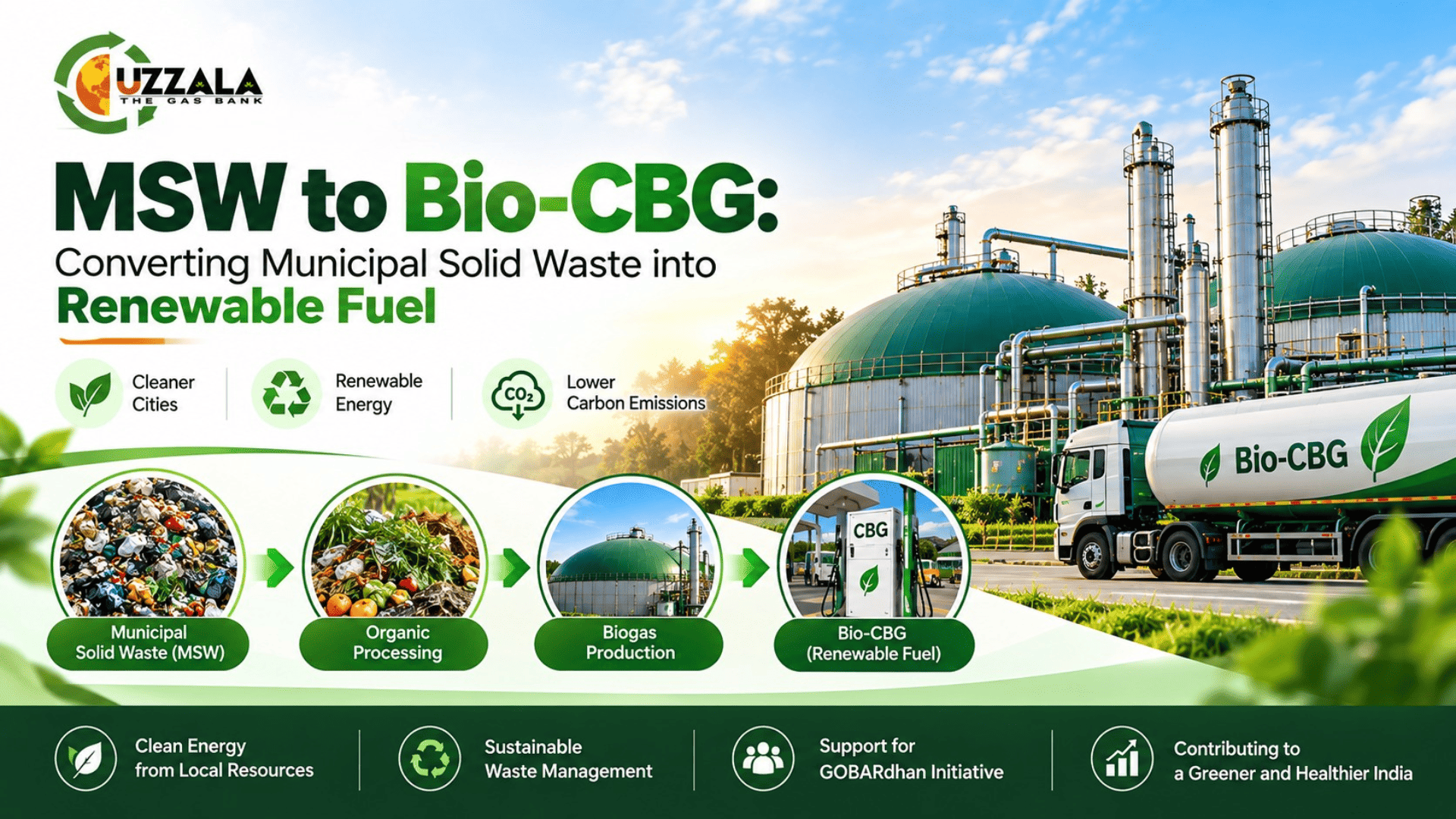
MSW to Bio-CBG: Converting Municipal Solid Waste into Renewable Fuel
India's growing cities are generating increasing quantities of municipal solid waste, creating a need for waste-management systems that can recover useful resources instead of treating waste only as a disposal problem. One emerging pathway is MSW to Bio-CBG, where the suitable biodegradable fraction of municipal solid waste can be processed through anaerobic digestion to generate biogas, which can then be purified, upgraded and compressed into renewable Compressed Biogas (CBG).
This approach connects municipal waste management, renewable fuel production, circular economy and waste-to-energy technology in a single value chain. The Government of India's GOBARdhan National Circular Bioenergy Scheme, approved in August 2026, includes municipal organic waste along with agricultural residues, cattle dung and other biomass resources within a national framework for producing clean energy and organic manure.
For municipalities, waste-management companies, renewable-energy developers and project investors, the important question is not simply whether waste can produce biogas, but how the available organic fraction can be consistently collected, prepared, digested and converted into commercially useful Bio-CBG.
What Is MSW to Bio-CBG?
MSW to Bio-CBG refers to the conversion of suitable biodegradable material present in Municipal Solid Waste into renewable compressed biogas.
Municipal waste is a mixed stream and can contain recyclable materials, inert materials, plastics, metals, glass and biodegradable organic matter. Therefore, an MSW Bio-CBG Plant requires appropriate waste segregation and feedstock preparation before the suitable organic material enters the biological conversion process.
A simplified process is:
Municipal Solid Waste → Segregation → Organic Feedstock Preparation → Anaerobic Digestion → Raw Biogas → Gas Cleaning → Biogas Upgrading → Compression → Bio-CBG
The exact configuration depends on waste composition, moisture, solids content, contamination levels, daily feedstock availability, plant capacity and the selected digestion technology.
Uzzala Bio Energy Solutions provides waste-to-biogas and Bio-CBG solutions for suitable organic feedstocks, including MSW, along with anaerobic digestion, biogas purification and CBG production technologies.
Why MSW to CBG Is Becoming Important in India
The development of Waste to CBG India projects reflects two connected requirements: managing organic waste responsibly and developing additional renewable fuel sources.
On 6 August 2026, the Union Cabinet approved the GOBARdhan National Circular Bioenergy Scheme with a total outlay of ₹23,731 crore for FY 2026–27 through FY 2035–36. The scheme includes municipal organic waste among the biomass resources that can support the production of clean fuel and organic manure. The Government has also stated an objective of substantially increasing domestic CBG production under the new framework.
For suitable projects, Municipal Solid Waste to CBG can support:
- Scientific treatment of biodegradable waste
- Renewable gas production
- Resource recovery from organic waste
- Reduction in dependence on fossil-based natural gas
- Development of local waste-to-energy infrastructure
- Production of organic fertilizer or manure from digestion residues
- Circular-economy applications
- New opportunities for municipalities and private project developers
This makes MSW to Bio-CBG Technology relevant not only to energy companies but also to urban local bodies and organizations responsible for municipal waste management.
How Municipal Waste Becomes Bio-CBG
The transformation from municipal waste to compressed biogas involves several technical stages.
1. Collection and Segregation
The first stage is the collection and segregation of municipal waste. The objective is to separate suitable biodegradable material from recyclables, inert matter and unwanted contaminants.
Effective segregation is important because an anaerobic digestion system requires an appropriate organic feedstock rather than an uncontrolled mixture of municipal waste.
2. Feedstock Preparation
The selected organic fraction may require preparation before digestion. Depending on the characteristics of the material, this can include sorting, size reduction, removal of contaminants and other pre-treatment operations.
The final preparation method should be selected according to the actual composition, moisture and solids characteristics of the available MSW.
3. Anaerobic Digestion
Prepared organic material is introduced into an anaerobic digestion system where microorganisms break down biodegradable matter in the absence of oxygen.
Different projects can require different reactor configurations. Uzzala Bio Energy Solutions works with CSTR Digesters and Dry Fermenters, along with dry and wet anaerobic digestion technologies.
4. Raw Biogas Generation
The digestion process produces raw biogas containing methane along with carbon dioxide, hydrogen sulphide, moisture and other components.
Raw biogas therefore requires further treatment before it can become a high-quality renewable compressed fuel.
5. Gas Cleaning and Upgrading
Gas-treatment systems are used to remove unwanted components and improve the quality of methane-rich gas.
Uzzala's listed technologies and services include H₂S Removal Systems, Water Scrubbers, PSA Biogas Upgrading and Membrane Biogas Separation.
The appropriate gas-upgrading technology depends on feed gas characteristics, required gas quality, plant capacity and the intended CBG application.
6. Compression into Bio-CBG
After suitable purification and upgrading, the gas can be compressed to produce Compressed Biogas (CBG) for appropriate applications.
This final stage connects waste treatment with renewable-fuel production.
What Feedstock Is Suitable for an MSW Bio-CBG Plant?
Not every component of municipal solid waste is suitable for anaerobic digestion. The quality and composition of the organic fraction are therefore critical.
Potential biodegradable feedstocks can include:
- Food waste
- Kitchen waste
- Vegetable and fruit market waste
- Other segregated organic municipal waste
- Suitable biodegradable commercial waste
- Selected agricultural or organic materials used for co-digestion
Uzzala's waste-to-biogas solutions identify MSW, household kitchen waste, food and vegetable market waste, pressmud, cow dung, poultry waste and agro-industrial slurry among potential feedstocks.
For this reason, a professional MSW Biogas Plant should begin with a feedstock assessment rather than selecting equipment solely on the basis of nominal daily waste quantity.
Technology Selection for MSW-Based Bio-CBG
Technology selection is one of the most important parts of a waste-to-CBG project.
A suitable configuration can depend on:
- Feedstock moisture
- Total solids
- Organic content
- Contamination level
- Daily waste availability
- Seasonal variations
- Required gas production
- Plant capacity
- Land availability
- Digestate-management requirements
- Desired automation level
- Gas purification requirements
CSTR Digester
A CSTR Digester is designed for suitable semi-solid and slurry-based organic feedstocks. Uzzala describes its CSTR technology for feedstocks including pressmud, cow dung, poultry waste, food waste and vegetable waste.
Dry Digestion Technology
For suitable higher-solids organic materials, Dry Digestion Technology can provide another project configuration.
Uzzala's portfolio includes dry digestion-based Bio-CBG projects and dry fermenter systems for appropriate feedstocks.
The important point is that there is no universal digestion technology for every MSW project. Feedstock characteristics should drive technology selection.
MSW to Bio-CBG and the Circular Economy
One of the important advantages of an MSW to Bio-CBG Plant is its ability to connect waste management with resource recovery.
Instead of viewing biodegradable municipal waste only as material requiring disposal, a properly designed project can create several outputs and benefits:
Organic Waste → Biogas → Bio-CBG + Organic Residuals
This model can contribute to a circular economy by recovering energy from biodegradable material and potentially converting digestion residues into useful organic fertilizer products, subject to applicable quality and regulatory requirements.
The current GOBARdhan policy framework further emphasizes the conversion of organic resources into clean energy, organic manure and economic value.
MSW to Bio-CBG for Sustainable Urban Waste Management
Cities require waste-management systems that can operate reliably over the long term. A Bio-CBG project can become one component of an integrated municipal waste-management strategy when the appropriate organic feedstock, collection system and processing infrastructure are available.
Potential stakeholders include:
- Municipal corporations
- Urban local bodies
- Waste-management companies
- Renewable-energy developers
- Infrastructure companies
- CBG project developers
- Industrial fuel users
- Organic-waste aggregators
- EPC companies
A successful project requires coordination between waste collection, segregation, transportation, feedstock processing, digestion, gas upgrading, CBG offtake and residual-material management.
Uzzala Bio Energy Solutions for MSW to Bio-CBG Projects
Uzzala Bio Energy Solutions is an Ahmedabad-based renewable-energy company working across Bio-CBG, biogas, biomethane and waste-to-energy applications.
The company's current specialization includes Bio-CBG Plants based on MSW, pressmud, poultry waste, food waste and agro waste, along with dry and wet anaerobic digestion technologies, CSTR digesters, dry fermenters, gas holders, organic-fertilizer systems, turnkey execution and plant automation.
Its listed services include:
- Bio-CBG Plant EPC Solutions
- MSW Biogas Plant Solutions
- CSTR Digester Technology
- Dry Digestion Technology
- PLUG FLOW Digester
- H₂S Removal Systems
- Water Scrubber Systems
- PSA Biogas Upgrading
- Membrane Biogas Separation
- Compressed Biogas Production
- Organic Fertilizer Systems
- Turnkey Project Execution
- Plant Automation
- Operation and Maintenance Support
Uzzala's technology portfolio demonstrates that digestion and gas-upgrading configurations can be selected according to feedstock characteristics and project requirements.
Uzzala's MSW to Bio-CBG Technology Discussion
Uzzala Bio Energy Solutions has also discussed its MSW to Bio-CBG technology in a video featuring Niraj Kumar Singh, Chief Operating Officer (COO), Uzzala Bio Energy Solutions.
The discussion provides additional insight into converting suitable municipal organic waste into renewable gas and the role of anaerobic digestion, biogas purification, upgrading and CBG production in an integrated waste-to-energy system.
Watch the MSW to Bio-CBG Discussion
https://www.youtube.com/watch?v=ywag-EpA538
The video provides an additional perspective on the opportunities associated with converting suitable municipal organic waste into renewable compressed biogas.
MSW to Bio-CBG and GOBARdhan
GOBARdhan stands for Galvanizing Organic Bio-Agro Resources Dhan and was launched in 2018 as part of India's efforts to convert biodegradable resources into useful products such as biogas and bio-slurry. The initiative has since become part of the country's broader circular-bioenergy framework.
In August 2026, the Union Cabinet approved the GOBARdhan National Circular Bioenergy Scheme, providing a larger national framework for the development of CBG and related bioenergy infrastructure.
The scheme includes municipal organic waste along with other biomass resources and aims to support the development of CBG production, organic-waste utilization, technology and infrastructure.
For MSW projects, the key consideration remains the availability of an appropriate organic feedstock stream and the ability to process it consistently.
Key Factors Before Setting Up an MSW to CBG Plant
Businesses and municipalities planning an MSW to CBG Plant should evaluate the project systematically.
Important considerations include:
- Daily waste availability: Is enough suitable organic material available consistently?
- Waste composition: What percentage is biodegradable?
- Segregation: Can suitable organic waste be separated effectively?
- Contamination: Are plastics, metals, glass and inert materials controlled?
- Feedstock logistics: How will waste reach the plant?
- Technology: Which digestion configuration matches the feedstock?
- Gas yield: What level of biogas production is technically achievable?
- Gas purification: What upgrading system is appropriate?
- Digestate: How will the solid and liquid residues be managed?
- CBG offtake: Where will the renewable gas be utilized or sold?
- Compliance: What environmental, safety and statutory approvals apply?
- Operations: Who will manage the facility after commissioning?
A detailed feasibility study can help determine whether an MSW-based Bio-CBG project is technically and commercially appropriate before major investment is made.
Future Scope of MSW to Bio-CBG in India
The combination of urban waste generation, renewable-fuel demand and India's circular-bioeconomy policies is creating new opportunities for MSW to Bio-CBG projects.
The GOBARdhan National Circular Bioenergy Scheme places municipal organic waste within a wider national framework for CBG production and waste-to-wealth development. The Government has stated that the scheme is intended to substantially increase domestic CBG production while supporting investment, technology development and related infrastructure.
For project developers, this creates an opportunity to examine municipal organic waste not simply as a disposal challenge, but as a potential renewable-resource stream.
However, successful implementation will depend on feedstock quality, segregation, technology selection, project economics, reliable operations and long-term offtake arrangements.
Why Choose Uzzala Bio Energy Solutions?
For organizations exploring Waste to CBG, Uzzala Bio Energy Solutions can support project development through a combination of technology and EPC capabilities.
Key areas include:
- MSW-based Bio-CBG project solutions
- Feedstock-specific technology planning
- Anaerobic digestion systems
- CSTR and dry digestion technologies
- Biogas purification and upgrading
- CBG production systems
- Waste-to-energy project execution
- Organic fertilizer integration
- Plant installation and commissioning
- Automation and technical support
- Operation and maintenance services
With its office in Ahmedabad, Gujarat, India, Uzzala Bio Energy Solutions works in the broader renewable-gas sector and has project presence across multiple Indian states.
For municipalities, developers and businesses evaluating Municipal Solid Waste to CBG, the right approach is to assess the available organic feedstock, processing requirements, technology options and end-use market together.
Frequently Asked Questions About MSW to Bio-CBG
1. What is MSW to Bio-CBG?
MSW to Bio-CBG is a waste-to-energy process in which suitable biodegradable material from municipal solid waste is converted into biogas through anaerobic digestion. The biogas is then cleaned, upgraded and compressed to produce Bio-CBG.
2. Can municipal solid waste be used for CBG production?
Yes, suitable organic municipal solid waste can be used as a feedstock for biogas and CBG projects. Proper segregation and feedstock preparation are essential because municipal waste is a mixed material stream.
3. What is the difference between MSW and organic MSW?
MSW contains many different materials, including organic matter, recyclables and inert materials. Organic MSW refers specifically to the biodegradable portion that can potentially be processed through biological treatment systems.
4. Which technology is used for an MSW Bio-CBG Plant?
The appropriate technology depends on the feedstock characteristics. Options can include CSTR, dry digestion, dry fermenters and other anaerobic digestion configurations. Uzzala Bio Energy Solutions provides both dry and wet digestion solutions.
5. How is biogas converted into Bio-CBG?
Raw biogas is first subjected to appropriate cleaning and upgrading to remove unwanted components and increase methane concentration. The upgraded gas is then compressed for Bio-CBG applications.
6. Is GOBARdhan related to CBG production?
Yes. The current national GOBARdhan framework includes the conversion of organic resources, including municipal organic waste, into Compressed Biogas and organic manure.
7. Can MSW-based Bio-CBG plants produce organic fertilizer?
The digestion process generates residual material that can potentially be processed into organic fertilizer or manure, depending on feedstock quality, treatment process and applicable standards.
8. What should be checked before installing an MSW to CBG plant?
The most important factors include waste quantity, organic fraction, contamination, moisture, segregation, transportation, digestion technology, gas yield, purification, digestate management and CBG offtake.
9. Who provides MSW to Bio-CBG solutions in India?
Uzzala Bio Energy Solutions, based in Ahmedabad, Gujarat, provides Bio-CBG and waste-to-energy solutions, including MSW-based projects, anaerobic digestion technologies, biogas purification and CBG production systems.
10. Why is MSW to Bio-CBG important for India's renewable-energy transition?
It can connect urban organic-waste management with renewable fuel production, helping create a circular pathway for recovering energy from suitable biodegradable waste while supporting broader waste-to-wealth and clean-energy objectives.
MSW to Bio-CBG represents a practical intersection of municipal waste management and renewable fuel production. By separating suitable organic material, applying appropriate anaerobic digestion technology and integrating gas purification and compression systems, municipal organic waste can become a potential source of renewable compressed biogas.
For project developers, however, technology alone is not enough. A successful MSW to Bio-CBG Plant requires reliable feedstock, effective segregation, suitable process design, appropriate gas-upgrading technology, responsible residual management and a practical CBG utilization strategy.
Uzzala Bio Energy Solutions provides Bio-CBG, biogas and waste-to-energy engineering solutions from its Ahmedabad, Gujarat base, with capabilities spanning feedstock-specific digestion, gas purification, upgrading, CBG production and turnkey project execution.
Website: www.uzzalabioenergy.com
Call: +91-82006 18329
Office: Ahmedabad, Gujarat, India
