
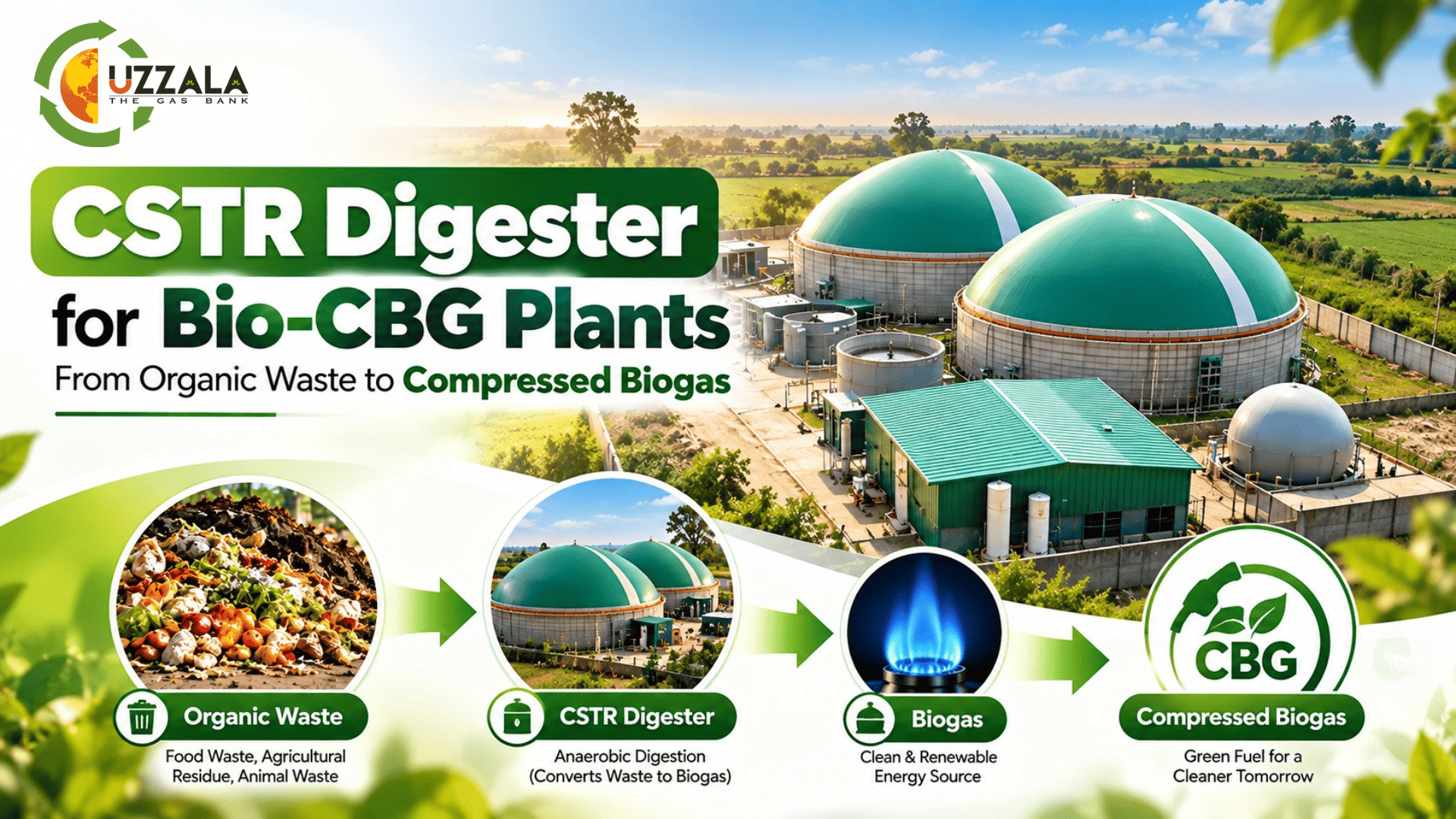
CSTR Digester for Bio-CBG Plants: From Organic Waste to Compressed Biogas
Organic waste can become a valuable source of renewable energy when processed with suitable anaerobic digestion technology. A CSTR Digester for Bio CBG plants provides a controlled environment in which microorganisms convert biodegradable materials into raw biogas. This gas can then be purified, upgraded, and compressed to produce Bio-Compressed Biogas (Bio-CBG) for suitable commercial and industrial applications.
As India expands its renewable energy and waste management infrastructure, businesses are exploring efficient ways to convert agricultural residues, industrial organic waste, and other biodegradable materials into useful fuel. Selecting the right digester, gas purification system, and project engineering partner is essential for achieving reliable plant performance.
Uzzala Bio Energy Solutions, based in Ahmedabad, Gujarat, works in the biogas and Bio-CBG sector, supporting project discussions around digestion technology, gas upgrading, and integrated plant requirements. This guide explains how CSTR digesters work, their role in Bio-CBG production, important design considerations, and how businesses can evaluate suitable waste-to-energy solutions.
What Is a CSTR Digester for Bio-CBG Plants?
A Continuous Stirred Tank Reactor (CSTR) digester is an anaerobic digestion vessel designed to process organic feedstock under controlled conditions. Organic material is mixed inside the reactor to help distribute heat, nutrients, microorganisms, and feedstock throughout the tank.
During anaerobic digestion, microorganisms break down biodegradable compounds in the absence of oxygen and produce biogas containing methane and carbon dioxide, along with smaller quantities of other gases.
In a Bio-CBG facility, the CSTR digester is one component of a complete production system. The plant may include:
-
Organic waste receiving and feedstock preparation
-
Slurry preparation and controlled feeding
-
CSTR anaerobic digestion
-
Raw biogas collection and conditioning
-
Hydrogen sulphide (H₂S) and moisture removal
-
Methane upgrading using suitable gas separation technology
-
Gas compression, storage, and delivery
-
Digestate handling and potential nutrient recovery
The design depends on feedstock characteristics, project capacity, operating conditions, and the intended use of the final gas. A digester should therefore be selected as part of the complete process rather than as an isolated piece of equipment.
How Does a CSTR Digester Convert Organic Waste into Bio-CBG?
The transformation from organic waste to compressed biogas involves several connected stages.
1. Feedstock Collection and Assessment
The first step is to identify the type, quantity, and consistency of organic material available for processing. Potential feedstocks include:
-
Cattle dung and suitable animal waste
-
Pressmud from sugar mills
-
Food-processing residues
-
Selected agricultural waste
-
Organic waste from commercial food operations
-
Properly segregated biodegradable municipal waste
-
Other suitable industrial organic residues
Feedstock testing helps determine moisture content, total solids, volatile solids, biodegradability, contamination, and other relevant characteristics. These factors influence digester design, pretreatment requirements, and potential biogas production.
2. Feedstock Preparation and Slurry Formation
For conventional pumpable CSTR systems, feedstock is often blended with liquid to produce a slurry that can be pumped and mixed efficiently.
Depending on the material, preparation may involve screening, shredding, dilution, homogenisation, or removal of unwanted contaminants. Consistent preparation can help reduce blockages, improve feeding reliability, and support stable digestion.
3. Anaerobic Digestion Inside the CSTR
The prepared feedstock enters the reactor, where microorganisms break down organic matter through several biological stages: hydrolysis, acidogenesis, acetogenesis, and methanogenesis.
The resulting biogas contains methane, which provides its fuel value, and carbon dioxide. Process performance depends on parameters such as temperature, pH, organic loading rate, hydraulic retention time, mixing, and feedstock composition.
Properly managed digestion helps maintain biological stability and supports predictable operation. However, actual gas production varies according to the quality and quantity of feedstock and the design of the system.
4. Raw Biogas Treatment
Raw biogas generally requires conditioning before it enters the upgrading equipment. Depending on its composition, the treatment system may remove hydrogen sulphide, moisture, and other contaminants.
H₂S removal is particularly important because hydrogen sulphide can contribute to corrosion, equipment damage, and safety hazards. Gas cooling, condensate management, filtration, and other pretreatment measures may also be required.
The appropriate treatment configuration should be selected according to raw gas quality, flow rate, and the specifications of the downstream equipment.
5. Biogas Upgrading and Methane Separation
During upgrading, carbon dioxide and other unwanted components are separated from the raw biogas to increase methane concentration and achieve the required product quality.
Common upgrading technologies include:
-
Membrane gas separation: Uses selective gas permeation to separate methane from carbon dioxide and other components.
-
Water scrubbing: Uses differences in gas solubility to remove carbon dioxide and certain impurities.
-
Pressure Swing Adsorption (PSA): Uses adsorbent materials and pressure cycles to separate gas components.
The best option depends on raw gas composition, pretreatment requirements, methane recovery, energy consumption, maintenance, and the required output specifications.
6. Compression and Bio-CBG Delivery
After upgrading and quality verification, the methane-rich gas can be compressed using suitable equipment. Depending on the project, the system may include gas drying, compressors, storage cascades, safety instruments, and a connection to the intended distribution or consumption arrangement.
Compressed Biogas (CBG) must meet the applicable quality and safety requirements for its intended use. Compression alone does not turn untreated raw biogas into finished Bio-CBG; appropriate purification and upgrading are essential.
Why Is CSTR Digester Technology Important for Bio-CBG Production?
CSTR technology can be useful for projects that process pumpable organic slurries and require active mixing. Its suitability depends on the feedstock and the overall plant configuration.
Key benefits may include:
-
Continuous feed handling: Supports regular processing of suitable slurry-based feedstock.
-
Controlled operating conditions: Mixing helps maintain more uniform conditions throughout the reactor.
-
Flexible engineering: The system can be designed for different capacities and suitable feedstock combinations.
-
Integration with gas treatment: Can be combined with H₂S removal, moisture control, methane upgrading, and compression.
-
Waste valorisation: Enables suitable organic waste to be converted into renewable fuel.
-
Digestate recovery opportunities: Residual material may have potential for nutrient recovery or beneficial use, subject to quality testing and applicable requirements.
-
Industrial applications: Can be evaluated for suitable sugar mills, food-processing facilities, agricultural operations, and other organic-waste-producing sites.
A CSTR digester does not guarantee a particular gas yield or financial return. Reliable results depend on feedstock testing, sound engineering, process monitoring, equipment selection, and competent operation.
Important Design Factors for a CSTR Digester
Before installing a CSTR-based Bio-CBG plant, project developers should assess several technical factors.
Feedstock Quality and Availability
A plant requires a dependable supply of suitable organic material. Seasonal variation, contamination, transport distance, and inconsistent composition can affect plant utilisation and operating costs.
Organic Loading Rate
The organic loading rate represents the quantity of organic matter introduced into the digester relative to its working volume over time. Excessive loading can cause biological instability, while underloading can prevent the plant from using its capacity effectively.
Hydraulic Retention Time
Hydraulic retention time estimates how long the liquid portion of the feed remains in the reactor under the designed flow conditions. The required retention time depends on feedstock properties, temperature, process configuration, and the intended level of treatment.
Mixing and Temperature Control
The mixing system should be designed for the feedstock's solids content and viscosity. Temperature monitoring and control help maintain suitable conditions for anaerobic microorganisms.
Gas Handling and Safety
Gas collection, pressure management, leak detection, ventilation, condensate removal, and corrosion protection are important design considerations. Equipment should be selected for the operating conditions and installed according to applicable safety requirements.
Digestate Management
The project should include a plan for handling the material remaining after digestion. Testing, storage, transport, and potential use as a soil amendment or fertiliser must be considered in line with its quality and applicable regulations.
CSTR Digester vs. Plug Flow and Dry Digestion Technologies
Not every Bio-CBG project requires the same digestion method. Comparing technologies helps buyers select a process that matches their feedstock.
CSTR digestion is commonly considered for pumpable slurries that benefit from active mixing and controlled reactor conditions.
Plug Flow digestion may be suitable for certain higher-solids or more viscous feedstocks when the reactor and feeding arrangements are designed for those materials.
Dry digestion technology can be considered for selected organic waste streams with higher solids content. Depending on the system, it may reduce the need to dilute feedstock compared with slurry-based processes.
The right choice depends on:
-
Feedstock type, solids content, and biodegradability
-
Daily feedstock availability and seasonal variation
-
Water and energy requirements
-
Land availability and site conditions
-
Mixing, pumping, and pretreatment needs
-
Digestate handling arrangements
-
Gas upgrading and product quality requirements
-
Capital investment and long-term operating costs
A technical feasibility study should be completed before choosing a process or committing to expected gas output.
How to Choose a Bio-CBG Plant Manufacturer or EPC Partner
Businesses searching for the Best Biogas Plant Manufacturer should evaluate more than the equipment price. Digester performance depends on the complete process, from feedstock preparation to final gas quality.
When comparing providers, look for:
-
Experience with the proposed feedstock and digestion technology
-
Clear engineering and process design documentation
-
Properly selected gas purification and upgrading systems
-
Transparent capacity and performance assumptions
-
Installation, commissioning, and operator training arrangements
-
Preventive maintenance and after-sales support
-
Defined equipment scope, warranties, and project responsibilities
-
Realistic financial estimates supported by technical assumptions
A Sustainable Biogas Technology Company in India should be able to explain how its proposed solution addresses feedstock variability, energy use, process stability, emissions control, digestate management, and long-term operations.
Businesses comparing the Top Bio CBG companies in India should assess each provider against their specific project requirements rather than relying only on rankings or promotional claims. Relevant experience, engineering quality, technology suitability, and lifecycle costs are more useful decision factors.
Turnkey Biogas Projects in India: What Should Buyers Expect?
For businesses seeking Turnkey Biogas Projects India, it is important to understand exactly what is included in the proposed project scope.
Depending on the contract, an integrated project may cover:
-
Feedstock assessment and feasibility planning
-
Process engineering and equipment selection
-
Digester design and associated civil or mechanical works
-
Feedstock handling and slurry preparation
-
Biogas collection and purification
-
Bio-CBG upgrading and compression
-
Electrical systems, automation, and instrumentation
-
Installation, testing, and commissioning
-
Operator training and maintenance planning
Buyers should confirm which activities are included, which are excluded, and who is responsible for approvals, utilities, civil works, feedstock supply, and gas offtake arrangements.
SATAT Bio-CBG Plants in India and Project Planning
The Sustainable Alternative Towards Affordable Transportation (SATAT) initiative helped bring attention to compressed biogas as a potential transport fuel and created a framework for encouraging CBG production and offtake through participating oil and gas companies.
When evaluating SATAT Bio CBG Plants in India, developers should verify the latest programme conditions, procurement arrangements, applicable quality specifications, and commercial requirements with the relevant official organisations. Project economics should not rely on assumed purchase prices or guaranteed offtake without a documented agreement.
A well-planned project should assess:
-
Feedstock availability and delivered cost
-
Expected methane production based on credible feedstock data
-
Gas upgrading and compression requirements
-
Applicable approvals and environmental obligations
-
Potential offtake arrangements and gas specifications
-
Plant utilisation, operating costs, and financing
-
Digestate handling and possible revenue opportunities
Policy and commercial terms can change, so current conditions should be checked before making investment decisions.
Finding a Biogas Plant Near Me: What Local Buyers Should Check
Businesses searching online for a Biogas Plant Near Me may be looking for a nearby supplier, a project developer, equipment support, or an existing facility. The most suitable provider may not always be the closest one; technical capability and service coverage are also important.
Before choosing a local or regional partner, consider:
-
Whether the company serves your project location
-
Whether it understands locally available feedstocks
-
Whether installation and maintenance support are available
-
Whether the proposed technology matches your waste stream
-
Whether the company can explain gas purification and safety requirements
-
Whether it can provide a clear project scope and realistic operating assumptions
For project discussions with Uzzala Bio Energy Solutions, businesses can contact the Ahmedabad, Gujarat-based team to discuss their feedstock, capacity requirements, and potential biogas or Bio-CBG applications.
Waste-to-Energy Opportunities for Industries
The wider waste-to-energy sector includes technologies that convert suitable waste into useful energy products. Depending on the waste stream, these may include anaerobic digestion, thermal treatment, and other recovery processes.
When evaluating a Top Waste to Energy Company in India, buyers should first establish whether the proposed technology suits their particular waste stream. Anaerobic digestion is generally intended for biodegradable organic materials, while mixed or non-biodegradable waste may require sorting or a different treatment route.
Similarly, searching for a Top Organic Waste to Energy Plant in India should lead to an assessment of feedstock acceptance criteria, treatment capacity, environmental controls, energy recovery, residual waste management, and operational performance—not just the advertised plant size.
For suitable biodegradable feedstocks, CSTR-based digestion can be part of an integrated strategy that links organic waste management with renewable gas production.
Why Consider Uzzala Bio Energy Solutions?
Uzzala Bio Energy Solutions works in the biogas and Bio-CBG sector, supporting discussions around digestion technologies and integrated renewable gas projects.
When planning a CSTR-based facility, project developers should work with a partner who can help assess feedstock characteristics, reactor requirements, gas treatment, upgrading, compression, and operating considerations as part of the complete system.
Before finalising a project, Uzzala and the project owner should establish the technical scope, feedstock assumptions, required output specifications, equipment responsibilities, installation arrangements, and service expectations.
Whether you are exploring an industrial waste-to-energy project or evaluating a Bio-CBG facility, a project-specific feasibility assessment can help identify the appropriate technology and commercial considerations.
A CSTR Digester for Bio CBG plants can provide the biological foundation for converting suitable organic waste into raw biogas. When integrated with effective gas conditioning, methane upgrading, compression, and safe operating systems, it can support the production of renewable compressed biogas.
Choosing the right technology requires a thorough understanding of feedstock quality, reactor design, operating parameters, gas treatment, digestate management, and project economics. Businesses should compare technology providers and EPC partners on technical suitability, transparency, support, and the complete lifecycle requirements of the facility.
For information about biogas and Bio-CBG project requirements, contact Uzzala Bio Energy Solutions.
Website: www.uzzalabioenergy.com
Call: +91-82006 18329
Office: Ahmedabad, Gujarat, India
Frequently Asked Questions (FAQs)
1. What is a CSTR digester for Bio-CBG plants?
A CSTR digester is a mixed-tank anaerobic reactor that processes suitable biodegradable feedstock to produce raw biogas. The gas is subsequently treated and upgraded to meet the requirements for Bio-CBG production.
2. How does a CSTR digester convert organic waste into compressed biogas?
Organic waste is prepared and fed into the digester, where microorganisms produce biogas without oxygen. The gas is then conditioned, upgraded to increase methane concentration, quality-checked, and compressed for its intended application.
3. Which feedstocks are suitable for CSTR-based Bio-CBG plants?
Depending on the design, potential feedstocks include cattle dung, pressmud, food-processing waste, and other suitable biodegradable materials. Laboratory testing helps determine whether pretreatment or blending is required.
4. What is the difference between a CSTR digester and a Plug Flow digester?
A CSTR typically uses active mixing and is commonly designed for pumpable slurries. Plug Flow systems may suit selected higher-solids or more viscous materials. The best option depends on feedstock characteristics and process requirements.
5. Which gas upgrading technologies are used in Bio-CBG plants?
Common options include membrane separation, water scrubbing, and pressure swing adsorption (PSA). Selection depends on raw gas composition, methane recovery, energy consumption, maintenance, and required gas quality.
6. What should buyers check when choosing the Best Biogas Plant Manufacturer?
Buyers should assess feedstock experience, engineering quality, equipment specifications, performance assumptions, safety provisions, commissioning support, maintenance services, and the overall project scope.
7. Are SATAT Bio-CBG plants suitable for every project?
Not automatically. Suitability depends on feedstock availability, plant economics, applicable programme conditions, product specifications, approvals, and viable offtake arrangements. Developers should verify current requirements with the relevant organisations.
8. How can I find a Biogas Plant Near Me?
Search for providers serving your project location, then verify their technical experience, service coverage, proposed technology, installation capabilities, and after-sales support. The closest supplier may not necessarily be the best technical match.
9. What is included in turnkey biogas projects in India?
Depending on the contract, turnkey scope may include engineering, digester systems, feedstock preparation, gas purification, upgrading, compression, automation, installation, commissioning, and training. Always confirm inclusions and exclusions before signing.
10. How do I evaluate a waste-to-energy plant for my business?
Start with waste characterisation, daily feedstock availability, technology suitability, energy output estimates, environmental requirements, residual waste management, operating costs, and potential energy offtake. A feasibility study helps establish whether the project is technically and commercially appropriate.
