
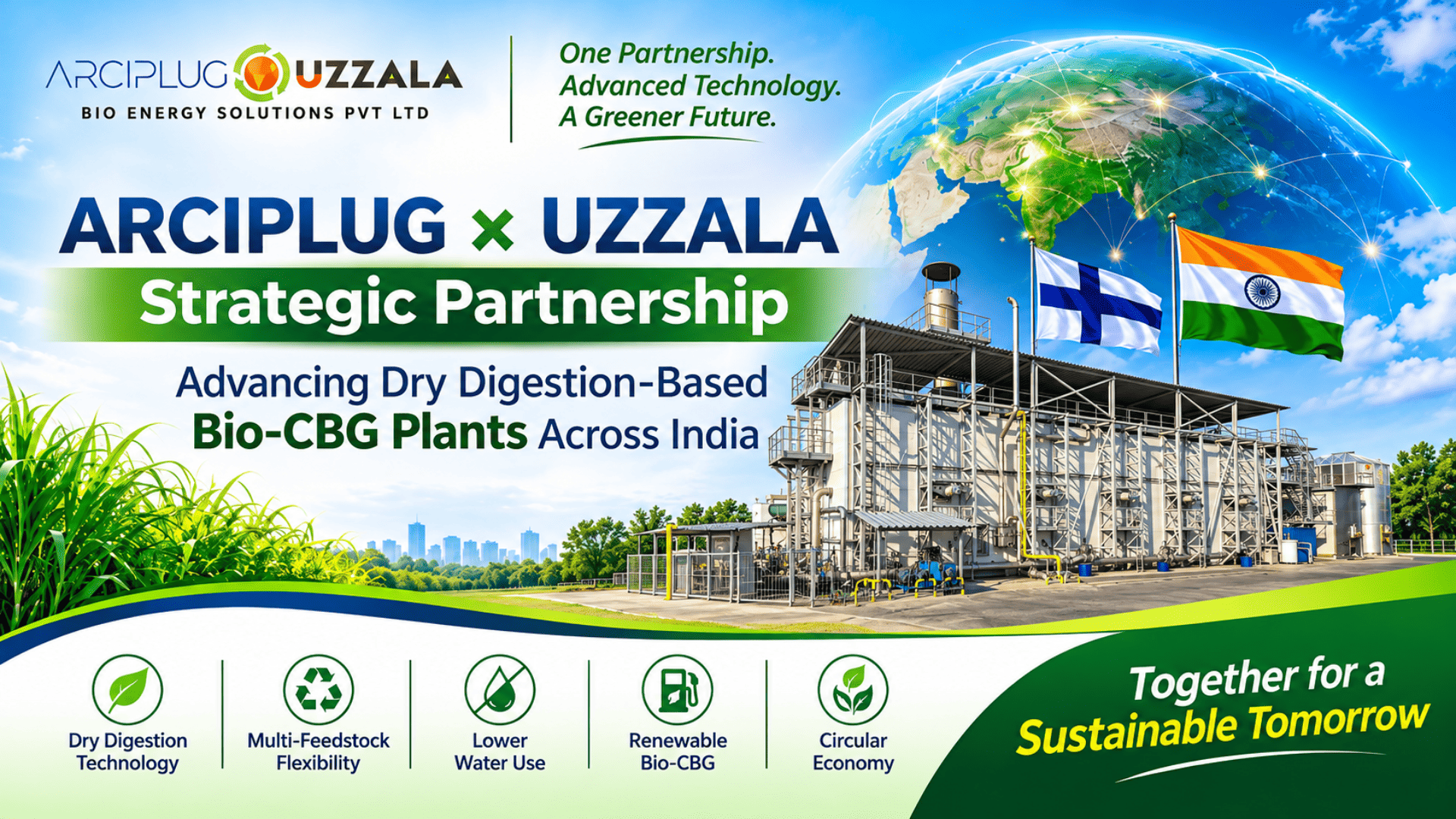
ARCIPLUG × UZZALA Strategic Partnership: Advancing Dry Digestion-Based Bio-CBG Plants Across India
India's renewable energy sector is exploring new ways to convert agricultural residues, organic waste and other biodegradable materials into clean and useful energy. Bio-CBG (Compressed Biogas) is gaining importance in this transition because it connects renewable fuel production with waste management, agriculture and resource recovery.
A significant development in this sector is the strategic partnership between Finland-based ARCIPLUG and India's Uzzala Bio Energy Solutions through ARCIPLUG UZZALA BIO ENERGY SOLUTIONS PVT. LTD.
This international collaboration brings together ARCIPLUG's dry digestion technology expertise from Finland and Uzzala Bio Energy Solutions' Bio-CBG engineering, procurement and construction (EPC) capabilities in India. The partnership aims to accelerate the development of advanced dry digestion-based Bio-CBG plants across India.
Its areas of focus include multi-feedstock processing, utilisation of Napier Grass and agricultural waste, efficient resource management and technology solutions designed to reduce water requirements in suitable applications.
The broader vision is to support India's clean energy transition, encourage waste-to-energy development and contribute to a more diversified and sustainable energy ecosystem.

Watch the ARCIPLUG × UZZALA Partnership Launch
The partnership brings together international technology expertise and Indian Bio-CBG project development capabilities. Watch the launch video to learn about the collaboration and its vision for developing dry digestion-based Bio-CBG plants across India.
ARCIPLUG × UZZALA BIO ENERGY SOLUTIONS | A STRATEGIC JOINT VENTURE | PARTNERSHIP LAUNCH
Watch YouTube Video: https://www.youtube.com/watch?v=fItOg6Cw1us

ARCIPLUG × UZZALA: An International Clean Energy Partnership
The establishment of ARCIPLUG UZZALA BIO ENERGY SOLUTIONS PVT. LTD. represents a strategic collaboration between Finland-based technology expertise and India's Bio-CBG engineering capabilities.
ARCIPLUG contributes dry digestion technology knowledge, while Uzzala Bio Energy Solutions brings its understanding of the Indian Bio-CBG market and project execution requirements.
The partnership aims to develop advanced dry digestion-based Bio-CBG plants across different regions of India.
Its key objectives include:
-
Bringing advanced dry digestion technology expertise to the Indian Bio-CBG market.
-
Developing plants that can process suitable agricultural and organic waste feedstocks.
-
Exploring the potential of Napier Grass and agricultural biomass for renewable gas production.
-
Combining technology integration with engineering, procurement and construction capabilities.
-
Evaluating solutions designed to reduce water requirements.
-
Supporting waste-to-energy projects and circular resource utilisation.
-
Contributing to India's renewable energy and energy independence objectives.
The collaboration demonstrates how international technology partnerships can support the development of renewable energy infrastructure in India.
Understanding Dry Digestion Technology
Dry digestion is an anaerobic digestion process designed to process organic feedstocks with relatively high solids content.
During anaerobic digestion, microorganisms break down biodegradable organic matter in an oxygen-free environment. This biological process produces raw biogas, which primarily contains methane and carbon dioxide, along with smaller quantities of other gases and impurities.
The methane-rich portion can be recovered through suitable gas purification and upgrading systems to produce Bio-CBG.
Unlike conventional wet digestion systems, which generally use more liquid for processing, dry digestion systems are designed to handle thicker organic materials. This can make them relevant for selected agricultural residues and other high-solid feedstocks.
Potential feedstock categories include:
-
Napier Grass and other suitable energy crops.
-
Agricultural residues and crop waste.
-
Suitable segregated organic municipal waste.
-
Food and vegetable market waste.
-
Selected agro-industrial biodegradable materials.
Feedstock suitability depends on moisture content, solids concentration, biodegradability, contamination levels and the technical configuration of the plant. Proper feedstock assessment is therefore essential before selecting a digestion system.
ARCIPLUG's Plug Flow Dry Digester System
A key technology highlight of the ARCIPLUG × UZZALA partnership is the Dry Digester System powered by Plug Flow technology.
A Plug Flow Reactor is designed to move prepared organic feedstock through a digestion chamber in a controlled flow pattern. As the material progresses through the reactor, microorganisms break down biodegradable matter and generate biogas.
The partnership presentation highlights several features of the Plug Flow System.
1. High-Solid Feedstock Processing
The ARCIPLUG presentation states that its Plug Flow System can handle feedstocks with up to 40% solids. This capability may be relevant for suitable agricultural biomass and other high-solid organic materials.
Actual feedstock compatibility must be established through testing and project-specific engineering.
2. Lower Water Requirements
An important consideration in dry digestion is the potential to reduce the need for additional water and dilution during feedstock processing.
This can be valuable in locations where water availability, water consumption and material handling are important project considerations. Actual water requirements will depend on feedstock characteristics and the plant configuration.
3. Stable Microbial Activity
Microorganisms play a central role in anaerobic digestion. The Plug Flow configuration is designed to support controlled movement of feedstock through the reactor and suitable biological processing conditions.
Temperature, retention time, organic loading and feedstock consistency remain important factors in plant performance.
4. Methane-Yield Optimisation
The partnership presentation highlights methane-yield optimisation and faster ramp-up times as potential system benefits.
Actual methane production depends on feedstock quality, biodegradable content, process design and operating conditions.
5. Modular and Scalable Plant Design
Modular system design can provide flexibility when developing Bio-CBG projects of different capacities.
Depending on site requirements and feedstock availability, the technology may be evaluated for agricultural, commercial and industrial applications.

This image combines the leadership team with the company's engineering, procurement, construction, commissioning, automation and support capabilities. It also presents the Plug Flow reactor illustration and the technology benefits highlighted by the partnership.
Multi-Feedstock Processing: Napier Grass and Agricultural Waste
One of the major opportunities highlighted in the partnership announcement is the utilisation of multiple feedstock types for Bio-CBG production.
India generates substantial quantities of agricultural residues and biodegradable organic waste. Converting suitable materials into renewable fuel can support better resource utilisation and create additional opportunities for rural and industrial waste management.
Napier Grass for Bio-CBG Production
Napier Grass is an energy crop that can be considered for anaerobic digestion projects because of its biomass production potential.
For a Napier Grass-based Bio-CBG plant, important considerations include:
-
Reliable cultivation and feedstock availability.
-
Harvesting and transportation arrangements.
-
Feedstock chopping and preparation.
-
Moisture and solids content.
-
Digestion performance and retention time.
-
Gas production and upgrading requirements.
Dry digestion technology may be suitable for selected Napier Grass applications, subject to feedstock testing and engineering evaluation.
Agricultural Residues and Organic Waste
Beyond Napier Grass, the partnership's multi-feedstock approach may be evaluated for other suitable biodegradable materials, including crop residues, food waste, market waste and agro-industrial organic waste.
Using multiple feedstocks can provide opportunities to diversify raw material sourcing. However, different materials have different digestion characteristics. Mixing ratios, pre-treatment and process conditions must therefore be carefully designed.
A reliable feedstock supply strategy is an important part of planning any commercial Bio-CBG project.
How Dry Digestion Converts Organic Waste into Bio-CBG
A dry digestion-based Bio-CBG plant involves several interconnected process stages.
Step 1: Feedstock Collection and Preparation
Organic materials are collected, inspected and prepared. Depending on the feedstock, preparation may include sorting, size reduction, mixing and other pre-treatment processes.
Step 2: Feeding into the Dry Digester
Prepared feedstock is introduced into the Plug Flow Dry Digester System, which is designed to maintain suitable conditions for anaerobic digestion.
Step 3: Anaerobic Digestion and Biogas Generation
Microorganisms break down biodegradable organic matter in an oxygen-free environment. This produces raw biogas containing methane and carbon dioxide.
Step 4: Biogas Cleaning
Raw biogas requires cleaning before upgrading. Depending on its composition, the treatment system may include moisture removal, hydrogen sulphide removal and other gas-cleaning stages.
Step 5: Biogas Upgrading
The cleaned gas is processed using a suitable upgrading technology to separate carbon dioxide and increase methane concentration.
Step 6: Compression and Bio-CBG Production
The upgraded gas is compressed to the required pressure and prepared for storage, dispensing or distribution according to applicable standards and project requirements.
Step 7: Digestate Management
The remaining digestate is managed according to its characteristics and applicable environmental and agricultural requirements. Where suitable, treated digestate may be considered for use as an organic soil amendment.
15 TPD Bio-CBG Output Project in Ambala, Haryana
An important project development initiative highlighted by ARCIPLUG × UZZALA is the 15 TPD Bio-CBG output project in Ambala, Haryana.
This project reflects the partnership's objective of developing advanced dry digestion-based Bio-CBG infrastructure in India.
A project of this scale involves several technical and operational considerations:
-
Feedstock availability and assessment.
-
Plant capacity and process design.
-
Dry digestion technology integration.
-
Biogas collection and treatment.
-
Gas purification and upgrading.
-
CBG compression and storage.
-
Plant automation and monitoring.
-
Construction, commissioning and technical support.
The Ambala initiative demonstrates the partnership's focus on applying dry digestion technology to India's renewable gas development opportunities.
The 15 TPD figure represents the stated Bio-CBG output capacity of the project. It should not be interpreted as confirmation of commissioning or commercial operation without an official operational update.
Integrated Bio-CBG EPC and Project Execution Capabilities
A successful Bio-CBG project requires more than the installation of a digester. It needs coordinated engineering, equipment procurement, construction, process integration and operational support.
The ARCIPLUG UZZALA presentation identifies the following capabilities:
Engineering: Project planning, technical design, process engineering, feasibility considerations and system integration.
Procurement: Sourcing suitable equipment, components and materials for plant development, including digestion and gas-handling systems.
Construction: Site execution, installation and coordination of plant infrastructure, piping and instrumentation.
Commissioning: System inspection, start-up activities, biological ramp-up, performance testing and operator preparation.
Automation: Process monitoring, plant control systems and operational coordination.
Support: Technical guidance, operational assistance, spare parts and optimisation support.
By bringing these capabilities together, the joint venture aims to support the development of dry digestion-based Bio-CBG projects across India.
Leadership Behind ARCIPLUG UZZALA BIO ENERGY SOLUTIONS PVT. LTD.
The partnership presentation introduces four directors associated with the joint venture:
-
Niraj Kumar Singh
-
Dr. Alok Agrawal
-
Kirit Prajapati
-
Mika Rautiainen
Mika Rautiainen is associated with Finland-based ARCIPLUG and its dry digestion technology expertise. The leadership team represents the collaboration between the Finnish technology partner and the Indian Bio-CBG project development organisation.
This international association is central to the joint venture's objective of bringing technology, engineering and project execution together for India's renewable energy sector.
Supporting India's Clean Energy Transition and Energy Independence
India's renewable energy ambitions include developing alternative fuels, improving waste utilisation and strengthening domestic energy resources.
Bio-CBG can contribute to these objectives by converting suitable biodegradable materials into a renewable methane-rich fuel.
Dry digestion-based projects can also create opportunities to connect agricultural production, organic waste management and renewable fuel infrastructure.
The ARCIPLUG × UZZALA partnership aims to contribute through:
-
Development of dry digestion-based Bio-CBG plants.
-
Better utilisation of suitable agricultural biomass.
-
Conversion of organic waste into renewable energy.
-
Technology solutions designed around lower water requirements.
-
Opportunities for local project development and supporting infrastructure.
-
Contribution to a more circular approach to resource utilisation.
The partnership's vision is to support India's journey towards a cleaner and more diversified energy ecosystem.
Watch India's Biggest Clean Energy Partnership
The ARCIPLUG × UZZALA partnership brings together Finnish dry digestion technology expertise and Indian Bio-CBG EPC capabilities. Watch the video to learn more about the collaboration, its technology focus and its vision for developing Bio-CBG plants across India.
INDIA’S BIGGEST CLEAN ENERGY PARTNERSHIP | ARCIPLUG + UZZALA | DRY DIGESTION TECHNOLOGY
Watch YouTube Video: https://www.youtube.com/watch?v=PzxusbmSe8U
Carbon Credits and Circular Economy Opportunities
Bio-CBG projects may also create environmental and economic opportunities beyond renewable fuel production.
By processing suitable organic waste, projects can support improved waste management and potentially reduce emissions associated with certain waste disposal practices. Replacing fossil-based fuels with renewable gas may also contribute to emissions reductions, depending on the project and the fuel being displaced.
Eligible projects may explore carbon credit opportunities where they meet the requirements of an applicable carbon-crediting programme.
However, carbon credit generation is not automatic. It depends on project methodology, baseline calculations, monitoring, verification and applicable eligibility criteria.
A circular economy approach can also help connect agricultural feedstock production, renewable energy generation and responsible digestate management.
Why Consider ARCIPLUG UZZALA BIO ENERGY SOLUTIONS PVT. LTD.?
Organisations planning a Bio-CBG project need to evaluate technology suitability, feedstock availability, engineering expertise and project execution capabilities.
ARCIPLUG UZZALA BIO ENERGY SOLUTIONS PVT. LTD. brings together:
-
Finland-based ARCIPLUG dry digestion technology expertise.
-
Uzzala Bio Energy Solutions' Indian Bio-CBG EPC capabilities.
-
A focus on Plug Flow Dry Digester technology.
-
Multi-feedstock processing opportunities.
-
Engineering, procurement and construction capabilities.
-
Commissioning, automation and technical support.
-
A vision to develop dry digestion-based Bio-CBG plants across India.
Every project requires an individual technical and commercial assessment based on feedstock, location, capacity, investment and operating requirements.
Conclusion: One Partnership, Advanced Technology, A Greener Future
The ARCIPLUG × UZZALA strategic partnership represents an international collaboration for India's Bio-CBG and waste-to-energy sector.
By combining Finland-based dry digestion technology expertise with India's Bio-CBG engineering and EPC capabilities, the joint venture aims to accelerate the development of dry digestion-based Bio-CBG plants across the country.
Its focus on Plug Flow technology, multi-feedstock processing, Napier Grass and agricultural waste utilisation, lower water requirements and integrated project execution reflects the growing opportunities in renewable gas production.
Through initiatives such as the 15 TPD Bio-CBG output project in Ambala, Haryana, ARCIPLUG UZZALA BIO ENERGY SOLUTIONS PVT. LTD. aims to contribute to India's clean energy transition, circular economy and long-term energy independence.
One Partnership. Advanced Technology. A Greener Future.
Contact ARCIPLUG UZZALA BIO ENERGY SOLUTIONS PVT. LTD.
Website: www.uzzalabioenergy.com
Email: uzzalabio@gmail.com
Call: +91 82006 18329
Location: Ahmedabad, Gujarat, India

Frequently Asked Questions (FAQs) - ARCIPLUG UZZALA BIO ENERGY SOLUTIONS PVT. LTD
1. What is ARCIPLUG UZZALA BIO ENERGY SOLUTIONS PVT. LTD.?
It is a strategic joint venture between Finland-based ARCIPLUG and India's Uzzala Bio Energy Solutions, established to develop dry digestion-based Bio-CBG plants across India.
2. What is the main objective of the ARCIPLUG and UZZALA partnership?
The partnership aims to combine advanced dry digestion technology expertise from Finland with Indian Bio-CBG EPC capabilities to accelerate renewable energy and waste-to-energy project development.
3. What is dry digestion technology?
Dry digestion is an anaerobic digestion process designed to process organic materials with relatively high solids content. It converts suitable biodegradable feedstocks into biogas, which can be upgraded into Bio-CBG.
4. What is a Plug Flow Dry Digester System?
A Plug Flow Dry Digester System is designed to move organic feedstock through a digestion reactor in a controlled flow pattern, supporting anaerobic digestion and biogas generation.
5. Can dry digestion technology process Napier Grass?
Dry digestion may be considered for suitable Napier Grass-based Bio-CBG projects. Feedstock preparation, moisture content, solids concentration and digestion performance must be assessed before selecting the system.
6. What feedstocks can be used in dry digestion-based Bio-CBG plants?
Potential feedstocks include Napier Grass, agricultural residues, selected organic municipal waste, food waste and agro-industrial biodegradable materials. Suitability depends on feedstock characteristics and plant design.
7. What are the benefits of dry digestion technology?
Potential benefits include high-solid feedstock processing, reduced dilution requirements, lower water demand in suitable applications and opportunities for modular plant development. Actual performance depends on project-specific conditions.
8. What is the 15 TPD Bio-CBG project in Ambala, Haryana?
It is a project development initiative highlighted by ARCIPLUG × UZZALA, with a stated Bio-CBG output capacity of 15 tonnes per day. Its commissioning and operational status should be confirmed through an official update.
9. Can Bio-CBG plants generate carbon credits?
Eligible Bio-CBG projects may explore carbon credit opportunities if they meet the requirements of an applicable carbon-crediting programme. Credits are not automatic and require appropriate monitoring and verification.
10. How does Bio-CBG support India's energy independence?
Bio-CBG can provide a renewable methane-rich fuel produced from suitable organic waste and agricultural feedstocks. It can diversify domestic energy resources and support the transition towards cleaner fuels.
11. Does ARCIPLUG UZZALA provide EPC capabilities?
The joint venture presentation identifies engineering, procurement, construction, commissioning, automation and technical support capabilities for Bio-CBG plant development.
12. How can I contact ARCIPLUG UZZALA BIO ENERGY SOLUTIONS PVT. LTD.?
Visit www.uzzalabioenergy.com, email uzzalabio@gmail.com or call +91 82006 18329 for company and project enquiries.
