
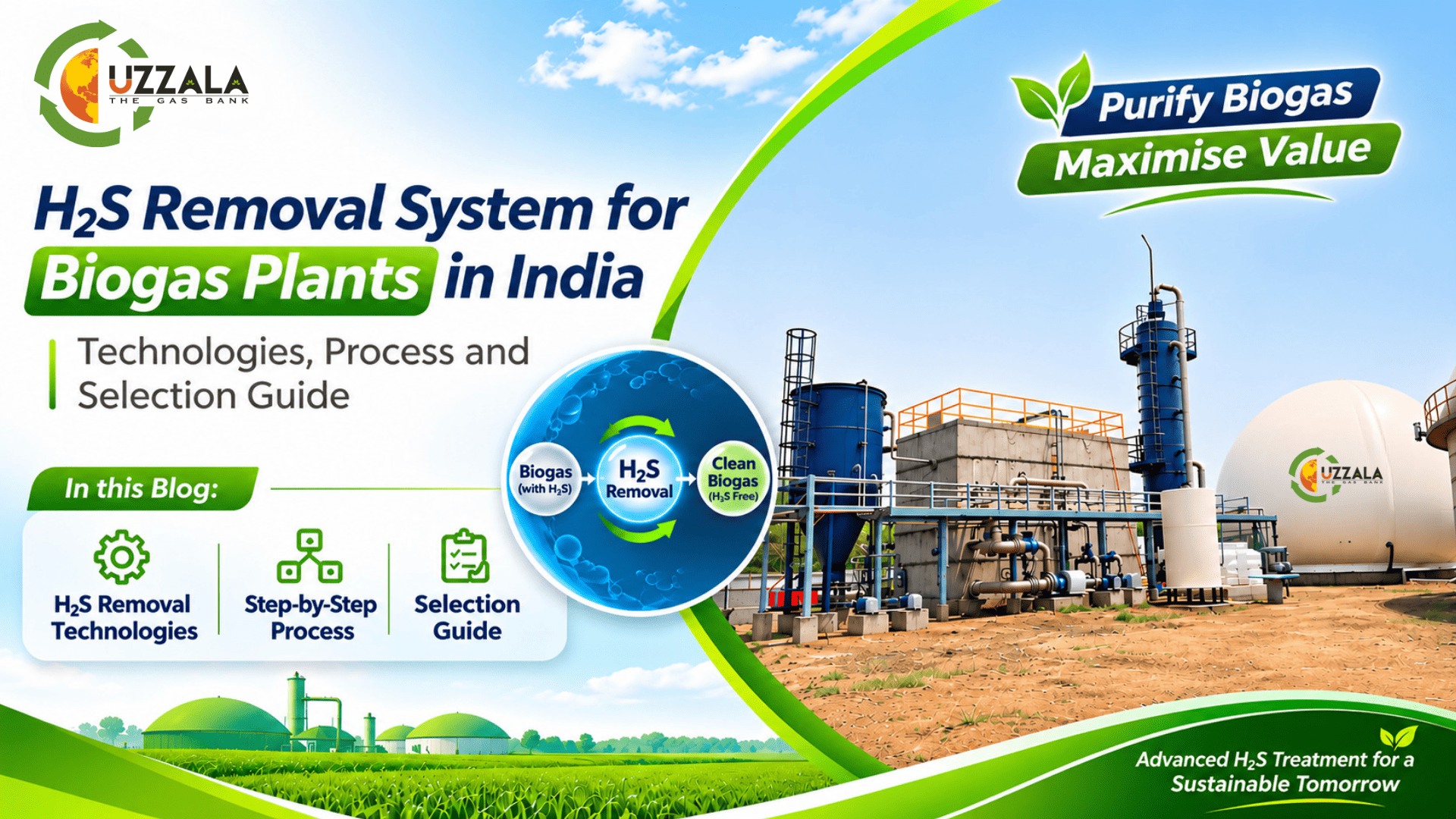
H2S Removal System for Biogas Plants in India: Technologies, Process and Selection Guide
Biogas is an important renewable energy source produced through the anaerobic digestion of biodegradable organic materials. However, raw biogas contains impurities that must be managed before the gas can be used in boilers, engines, power generation equipment or Bio-CBG production systems. One of the most important impurities is hydrogen sulphide (H₂S), a toxic and corrosive gas that can affect equipment reliability, gas quality and plant operating costs.
An efficient H2S Removal System for Biogas Plants helps reduce hydrogen sulphide concentration and prepares biogas for further utilisation or upgrading. Selecting the appropriate technology is essential for maintaining consistent gas quality, protecting downstream equipment and improving the overall reliability of a biogas project.
For Indian biogas and Bio-CBG projects, the right Biogas Desulphurization System depends on raw gas composition, flow rate, H₂S concentration, required outlet quality, operating conditions and the intended application.
Uzzala Bio Energy Solutions focuses on biogas and renewable gas project solutions, supporting the development of systems designed around project-specific technical requirements.
1. Introduction to H2S Removal in Biogas Plants
Raw biogas generally contains methane, carbon dioxide, water vapour and trace impurities. Hydrogen sulphide is one of the most important impurities because it can create corrosion problems and release harmful sulphur compounds during combustion.
The concentration of H₂S varies depending on feedstock composition, digestion conditions and biological activity. Biogas generated from certain organic wastes, agricultural residues, food processing waste and industrial biodegradable materials may contain significant amounts of hydrogen sulphide.
A properly designed H2S Removal System for Biogas Plants in India helps control this impurity before the gas enters sensitive equipment or downstream purification processes.
The main objectives of an H₂S removal system include:
-
Reducing hydrogen sulphide concentration in raw biogas.
-
Minimising corrosion in pipelines, compressors and gas-handling equipment.
-
Protecting engines, boilers and other gas-utilisation systems.
-
Improving the quality of biogas before upgrading.
-
Supporting reliable operation of Bio-CBG production facilities.
-
Reducing maintenance requirements associated with sulphur-related damage.
H₂S removal should be considered an essential part of an integrated biogas gas-cleaning strategy.
2. What Is Hydrogen Sulphide (H₂S) in Raw Biogas?
Hydrogen sulphide is a colourless gas containing hydrogen and sulphur. It can be generated during anaerobic digestion when sulphur-containing compounds in organic feedstocks are broken down by microorganisms.
Although its concentration can vary considerably, even relatively low concentrations can create operational concerns over time.
H₂S is particularly important because it is:
-
Highly toxic and dangerous to human health.
-
Corrosive in the presence of moisture.
-
Capable of forming sulphur dioxide during combustion.
-
Harmful to several types of gas-utilisation equipment.
-
An important parameter in raw biogas quality monitoring.
H₂S also has a characteristic rotten-egg smell at certain concentrations. However, smell must never be used to determine whether an environment is safe because exposure can rapidly impair the sense of smell.
For this reason, industrial biogas facilities require suitable gas detection, ventilation, safety procedures and engineered H₂S treatment systems.
3. Why Is H₂S Removal Important Before Biogas Utilisation?
Removing hydrogen sulphide is important for protecting equipment and maintaining the performance of a biogas facility.
Protection Against Corrosion
When hydrogen sulphide combines with moisture, it can contribute to corrosive conditions inside pipelines, storage equipment and other gas-handling components.
An effective Biogas Gas Cleaning System reduces this risk by controlling H₂S before the gas reaches downstream equipment.
Improved Equipment Reliability
Compressors, engines, blowers, valves and other components may be affected by sulphur-containing gas. Appropriate H₂S removal helps reduce exposure and supports longer equipment service life.
Better Gas Quality
Gas quality requirements vary according to the final application. H₂S removal helps prepare raw biogas for subsequent treatment, combustion or upgrading.
Protection of Biogas Upgradation Equipment
In Bio-CBG facilities, raw biogas passes through several treatment and upgrading stages. Excessive H₂S can affect downstream equipment and may interfere with selected purification processes.
A suitable H2S Removal Plant for Bio-CBG therefore forms an important part of the overall gas-treatment arrangement.
Environmental and Operational Considerations
Controlling sulphur compounds can help manage emissions and reduce operational problems associated with untreated biogas. The treatment and disposal of spent media, sulphur-rich residues and chemical by-products must also be handled responsibly.
4. Problems Caused by High H₂S Concentration
If hydrogen sulphide is not controlled properly, a biogas plant may experience several technical and operational challenges.
Common problems include:
-
Pipeline corrosion: Moisture and sulphur compounds can contribute to corrosion in gas distribution systems.
-
Compressor damage: Corrosive gas conditions can affect compressor components and associated equipment.
-
Engine maintenance: H₂S can contribute to wear, deposits and maintenance issues in gas engines.
-
Poor gas quality: High H₂S concentration may prevent biogas from meeting the requirements of its intended application.
-
Downstream treatment challenges: Excessive sulphur compounds can increase the burden on gas purification and upgrading equipment.
-
Safety risks: Hydrogen sulphide exposure presents a serious occupational hazard.
These issues highlight why an industrial H2S Scrubber for Biogas Plants should be selected according to actual gas characteristics rather than only the nominal plant capacity.
5. How Does an H₂S Removal System Work?
An industrial Biogas H2S Removal Technology system works by bringing hydrogen sulphide into contact with a suitable treatment medium or chemical process that captures, converts or removes the sulphur compound.
The exact operating principle depends on the selected technology.
A typical H₂S treatment arrangement may involve the following stages:
Step 1: Raw Biogas Inlet
Raw biogas enters the treatment system from the digester or gas collection arrangement. Its flow rate, pressure, temperature and H₂S concentration should be measured.
Step 2: Initial Gas Conditioning
Depending on the design, the gas may undergo moisture separation, cooling or filtration before entering the main H₂S treatment equipment.
Step 3: Hydrogen Sulphide Removal
The gas passes through the selected treatment stage, such as biological media, iron-based media, activated carbon or chemical scrubbing.
Step 4: Treated Gas Outlet
The treated biogas exits the removal system with a reduced H₂S concentration.
Step 5: Gas Quality Monitoring
The outlet gas is checked to confirm whether it meets the required H₂S specification for the next process or final application.
The required outlet concentration must be established from the specifications of downstream equipment, upgrading technology and applicable gas-quality requirements.
6. Different H₂S Removal Technologies for Biogas Plants
Different technologies are available for hydrogen sulphide removal. Each has its own operating principle, advantages and limitations.
A. Biological Desulphurisation
Biological desulphurisation uses specialised microorganisms to convert hydrogen sulphide into elemental sulphur or other oxidised sulphur compounds under controlled conditions.
Depending on the configuration, biological treatment may take place within the digester headspace or in a separate treatment unit.
Potential advantages:
-
Biological treatment can reduce the need for certain chemical consumables.
-
Suitable for continuous biogas treatment applications.
-
Can be integrated into appropriately designed biogas facilities.
-
May provide an effective option for selected gas flows and H₂S loads.
Important considerations:
-
Microorganisms require suitable operating conditions.
-
Oxygen or air dosing, where used, requires careful engineering and safety controls.
-
Temperature, moisture and biological activity influence performance.
-
Sulphur accumulation and removal must be managed.
B. Iron-Based Media
Iron-based treatment systems use reactive iron compounds to capture hydrogen sulphide through chemical reactions.
The biogas passes through a vessel containing iron-based media. H₂S reacts with the material and is retained as sulphur-containing compounds.
Potential advantages:
-
Relatively straightforward treatment arrangement.
-
Suitable for various biogas applications.
-
Can be designed as a replaceable-media filtration system.
-
Useful for controlling H₂S concentration in appropriately sized installations.
Important considerations:
-
Media consumption depends on the incoming H₂S load.
-
Replacement frequency must be planned.
-
Pressure drop should be monitored.
-
Spent media requires suitable handling and disposal or regeneration arrangements where applicable.
C. Activated Carbon Filtration
Activated carbon systems remove H₂S through adsorption and, depending on the media formulation and operating conditions, catalytic reactions.
Specially treated or impregnated activated carbon may be used to improve hydrogen sulphide removal performance.
Potential advantages:
-
Compact equipment configuration.
-
Useful for polishing applications.
-
Can achieve low outlet H₂S concentrations when correctly selected and operated.
-
Can be installed as part of a multi-stage gas-cleaning system.
Important considerations:
-
Media selection must match the gas composition and operating conditions.
-
Moisture and temperature can influence performance.
-
Media has a finite treatment capacity.
-
Breakthrough monitoring is essential to prevent untreated gas from passing downstream.
D. Chemical Scrubbing
Chemical scrubbing uses a suitable liquid reagent to absorb or react with hydrogen sulphide as the biogas passes through a contact system.
The selected chemical process depends on the required treatment performance, gas flow, H₂S concentration and operating requirements.
Potential advantages:
-
Can be designed for continuous industrial operation.
-
Treatment performance can be adjusted through process control.
-
Suitable for selected high-load or specialised gas-cleaning applications.
Important considerations:
-
Chemical consumption and storage must be managed.
-
Corrosion-resistant equipment may be required.
-
Spent liquid and chemical by-products need responsible treatment.
-
Operating costs depend on reagent consumption and process conditions.
7. Key Components of an Industrial H₂S Removal System
A complete H2S Removal System for Biogas Plants may include several components depending on the chosen treatment technology.
Important equipment and system elements include:
-
Gas inlet pipeline: Transfers raw biogas to the treatment unit.
-
Moisture separator: Removes liquid water droplets where required.
-
Blower or gas-moving equipment: Maintains the required gas flow and pressure.
-
H₂S treatment vessel: Contains the selected biological, iron-based or activated-carbon treatment arrangement.
-
Treatment media or chemical system: Provides the material or reaction mechanism for removing H₂S.
-
Pressure and temperature instruments: Monitor operating conditions.
-
H₂S analysers: Measure incoming and treated gas concentrations.
-
Flow measurement instruments: Help assess gas throughput and treatment loading.
-
Safety devices: Include suitable gas detection, isolation and protection arrangements.
-
Outlet pipeline: Transfers treated gas to the next treatment stage or application.
The equipment configuration should be determined through engineering design rather than using a standard arrangement for every project.
8. Factors to Consider When Selecting an H₂S Removal System
Choosing the right H2S Removal System Manufacturer in India or technology supplier requires a clear understanding of the project's operating requirements.
Before selecting a system, consider the following factors:
1. Raw Biogas Flow Rate
The system must be designed for the actual gas flow, including expected variations in production and peak operating conditions.
2. Incoming H₂S Concentration
H₂S concentration determines the treatment load and influences the choice of technology, media quantity and vessel sizing.
3. Required Outlet H₂S Level
The target outlet concentration should be based on downstream equipment specifications and the final use of the gas.
4. Feedstock Characteristics
Different feedstocks can produce different raw biogas compositions. Regular gas analysis helps identify changes in H₂S loading.
5. Operating Pressure and Temperature
Treatment vessels and associated equipment must be suitable for the actual operating conditions.
6. Maintenance Requirements
Media replacement, chemical replenishment, cleaning, inspection and instrument calibration should be considered during technology selection.
7. Total Operating Cost
Compare not only the initial equipment cost but also:
-
Media or chemical consumption.
-
Electricity requirements.
-
Maintenance expenses.
-
Replacement intervals.
-
Waste handling costs.
-
Instrumentation and monitoring requirements.
8. Future Plant Expansion
A modular or expandable treatment arrangement may be useful when future increases in biogas production are expected.
A detailed technical evaluation helps identify a Biogas Desulphurization System that matches the plant's actual operating needs.
9. H₂S Removal for Bio-CBG and Biogas Upgradation Plants
In Bio-CBG production facilities, raw biogas must undergo suitable cleaning and upgrading before it can become a methane-rich renewable fuel.
H₂S removal is an important part of this process because sulphur compounds can affect downstream gas-treatment equipment and final gas quality.
A typical treatment arrangement may include:
-
Raw biogas collection.
-
Moisture and particulate removal.
-
Hydrogen sulphide removal.
-
Additional gas conditioning.
-
Carbon dioxide separation and methane enrichment.
-
Final gas-quality monitoring.
-
Compression and storage.
The precise sequence depends on the selected upgrading technology and its feed-gas specifications.
For a Biogas Upgradation Plant, H₂S treatment should be coordinated with the gas-upgrading supplier to ensure compatibility with membranes, adsorbents, compressors and other downstream components.
An appropriately designed H2S Removal Plant for Bio-CBG can support reliable operation and help protect the investment in the overall gas purification facility.
10. Maintenance and Performance Monitoring
Installing an H₂S removal system is only the first step. Continuous monitoring and planned maintenance are necessary to maintain treatment performance.
Recommended maintenance practices include:
-
Regular measurement of inlet H₂S concentration.
-
Monitoring of treated gas H₂S levels.
-
Recording gas flow, pressure and temperature.
-
Checking pressure drop across treatment vessels.
-
Inspecting pipelines, valves and vessel connections.
-
Monitoring activated carbon or iron-based media condition.
-
Maintaining chemical dosing systems where applicable.
-
Checking biological treatment conditions.
-
Calibrating gas analysers according to manufacturer recommendations.
-
Maintaining records of media replacement and system performance.
One important practice is monitoring the difference between inlet and outlet H₂S concentration. A sudden reduction in removal efficiency may indicate media exhaustion, channeling, process instability or another equipment issue.
Digital gas analysers, automated process monitoring and remote operating dashboards can also support modern biogas plant management.
11. Why Choose Uzzala Bio Energy Solutions?
Selecting a suitable technology partner is important when planning a new biogas facility or improving an existing gas-cleaning arrangement.
Uzzala Bio Energy Solutions works in the renewable energy and Bio-CBG project sector, with a focus on technology integration and project-specific engineering requirements.
When evaluating an H₂S treatment solution, project owners should consider:
-
Assessment of raw biogas composition and H₂S concentration.
-
Selection of suitable biogas desulphurisation technology.
-
Integration with existing biogas collection and purification equipment.
-
Compatibility with downstream Bio-CBG upgrading systems.
-
Gas-quality monitoring and instrumentation requirements.
-
Maintenance planning and operating considerations.
-
Scope for future capacity expansion.
Every biogas project has different feedstock characteristics, gas flow requirements and operating conditions. Therefore, the right H2S Removal System for Biogas Plants should be selected after a technical assessment of the application.
For project enquiries and renewable gas solutions, contact Uzzala Bio Energy Solutions.
12. Frequently Asked Questions (FAQs)
1. What is an H2S Removal System for Biogas Plants?
An H₂S removal system is equipment designed to reduce hydrogen sulphide concentration in raw biogas. It helps protect gas pipelines, compressors, engines and downstream purification equipment from sulphur-related problems.
2. Why is hydrogen sulphide removed from biogas?
Hydrogen sulphide is toxic and corrosive, particularly in the presence of moisture. Removing it helps improve gas quality, protect equipment and prepare biogas for utilisation or upgrading.
3. Which H₂S removal technology is best for biogas plants?
The best technology depends on gas flow, incoming H₂S concentration, required outlet quality, operating conditions and maintenance requirements. Biological desulphurisation, iron-based media, activated carbon and chemical scrubbing are commonly considered options.
4. What is a Biogas Desulphurization System?
A Biogas Desulphurization System is a gas-treatment arrangement designed to remove hydrogen sulphide and other sulphur compounds from raw biogas using suitable biological or chemical treatment methods.
5. Can activated carbon remove H₂S from biogas?
Yes. Specially selected activated carbon media can remove hydrogen sulphide through adsorption and catalytic reactions. Its performance depends on media formulation, moisture, temperature, gas composition and operating conditions.
6. What is the difference between biological and chemical H₂S removal?
Biological desulphurisation uses microorganisms to convert hydrogen sulphide into sulphur compounds, while chemical treatment uses reagents to absorb or react with H₂S. Their operating requirements, consumables and maintenance needs differ.
7. Is H₂S removal necessary before Bio-CBG production?
H₂S removal is generally an important gas-conditioning step before biogas upgrading. The required treatment level and process arrangement depend on the specifications of the selected upgrading technology.
8. How can I monitor H₂S removal efficiency?
H₂S removal efficiency can be assessed by measuring inlet and outlet H₂S concentrations using suitable gas analysers. Regular monitoring helps identify treatment-media exhaustion and changes in system performance.
9. How often should H₂S removal media be replaced?
Replacement frequency depends on incoming H₂S concentration, gas flow, media capacity, moisture conditions and operating hours. Monitoring outlet gas quality is more reliable than following a fixed replacement schedule alone.
10. What factors affect the cost of an H₂S removal system in India?
Important cost factors include gas flow rate, inlet H₂S concentration, required outlet quality, treatment technology, vessel size, media or chemical consumption, instrumentation and installation requirements.
11. Can an H₂S removal system be installed in an existing biogas plant?
Yes, a suitable treatment system can often be integrated into an existing facility after evaluating gas flow, pressure, pipeline arrangement, available space and downstream equipment requirements.
12. How do I select an H₂S Removal System Manufacturer in India?
Evaluate the supplier's technical understanding, treatment technology options, gas-flow and H₂S-load assessment, equipment design, instrumentation, maintenance support and compatibility with your biogas application.
Conclusion
Hydrogen sulphide control is an important requirement for reliable biogas utilisation and Bio-CBG production. High H₂S concentrations can create corrosion, equipment maintenance and gas-quality challenges if they are not managed properly.
An appropriately selected H2S Removal System for Biogas Plants helps reduce these risks and supports effective integration with downstream gas purification and upgrading processes.
Whether a project requires biological desulphurisation, iron-based media, activated carbon filtration or chemical scrubbing, the technology should be selected according to actual gas composition, flow rate, operating conditions and outlet specifications.
With the right engineering approach, gas-quality monitoring and planned maintenance, biogas operators can improve treatment reliability and protect their renewable energy infrastructure.
Uzzala Bio Energy Solutions supports India's growing renewable energy sector through Bio-CBG and biogas project solutions.
Contact Uzzala Bio Energy Solutions
Website: www.uzzalabioenergy.com
Call: +91-82006 18329
Office: Ahmedabad, Gujarat, India
Discuss your biogas project requirements and explore suitable gas-cleaning and Bio-CBG solutions.
