
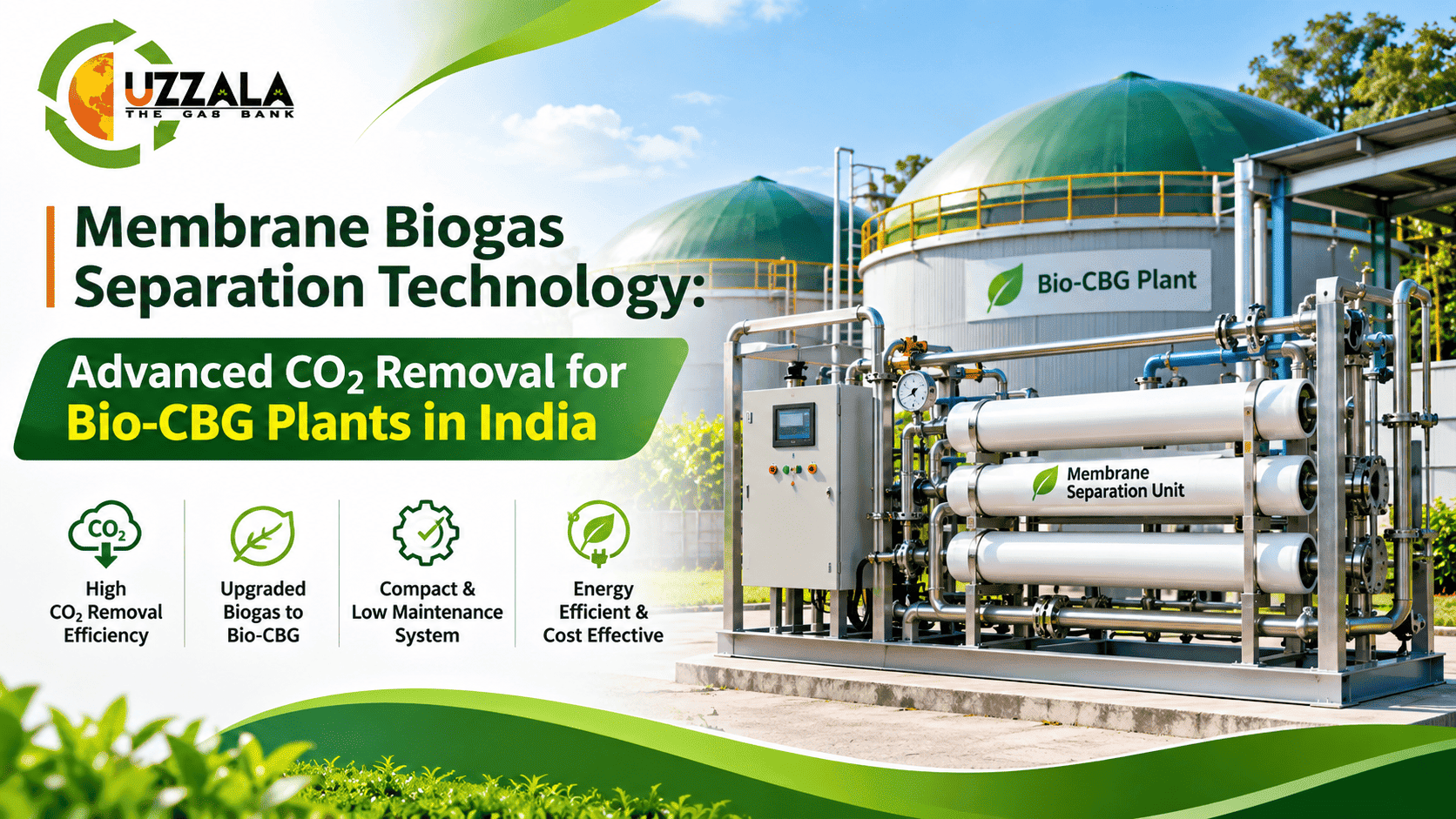
Membrane Biogas Separation Technology: Advanced CO₂ Removal for Bio-CBG Plants in India
The growing demand for renewable fuels is encouraging industries and project developers to explore advanced biogas purification technologies. Biogas generated from organic waste contains methane (CH₄), carbon dioxide (CO₂), moisture and other impurities. To produce high-quality biomethane for Bio-CBG and Bio-CNG applications, these unwanted components must be reduced through an appropriate upgrading process.
Membrane Biogas Separation is an advanced gas-upgrading technology that separates carbon dioxide from methane using specially designed membrane materials. It offers a compact, modular approach to biogas purification and biomethane production, making it an important technology option for modern Bio-CBG projects.
For Indian renewable-energy projects, selecting the right Membrane Biogas Upgradation Plant requires evaluating raw biogas composition, required methane purity, recovery efficiency, energy consumption and operating conditions.
1. What Is Membrane Biogas Separation?
Membrane Biogas Separation is a gas purification process that uses selective permeability to separate different gases present in raw biogas.
The membrane allows certain gas molecules to pass through more easily than others. In many biogas upgrading applications, carbon dioxide passes through the membrane faster than methane, allowing methane-rich gas to be collected as the upgraded product.
A typical raw biogas composition may include:
-
Methane (CH₄)
-
Carbon dioxide (CO₂)
-
Hydrogen sulphide (H₂S)
-
Water vapour
-
Small quantities of nitrogen and oxygen
The exact composition depends on the feedstock, digestion process and plant operating conditions.
The main objective of Biogas Membrane Separation Technology is to reduce CO₂ concentration while retaining as much methane as possible.
This process helps convert raw biogas into biomethane that can be further conditioned and compressed for suitable Bio-CBG applications.
2. How Does Membrane Separation Work?
A Membrane Biogas Purification System generally uses selective gas-permeation membranes arranged in one or more separation stages.
The process involves several important steps:
1. Raw Biogas Collection
Biogas generated inside an anaerobic digester is collected and transferred to the gas-treatment section.
2. Gas Pretreatment
Before entering the membrane system, raw biogas generally requires treatment to remove moisture, hydrogen sulphide, particles and other contaminants that could affect membrane performance.
3. Compression
The pretreated gas is compressed to the operating pressure required by the selected membrane system.
4. Membrane Separation
The pressurised gas passes through membrane modules. CO₂ and other faster-permeating gases pass through the membrane more readily than methane.
5. Methane-Rich Gas Collection
The methane-rich stream is collected as upgraded gas. Depending on the system configuration, additional membrane stages or gas-recycling arrangements may be used to improve methane recovery.
6. Final Gas Conditioning
The upgraded biomethane is checked for the required gas-quality parameters and processed further for its intended application, including compression where necessary.
The final performance depends on membrane characteristics, feed-gas quality, operating pressure, stage configuration and process control.
3. CO₂ Removal and Methane Recovery Process
Effective CO₂ Removal from Biogas is essential for producing upgraded biomethane.
Carbon dioxide reduces the methane concentration and heating value of raw biogas. Membrane separation helps reduce CO₂ concentration while retaining methane in the product stream.
However, methane purity and methane recovery are two different performance measurements.
-
Methane purity: The percentage of methane present in the upgraded gas.
-
Methane recovery: The proportion of methane entering the system that is retained in the product gas.
A system may produce high methane purity but still lose an undesirable amount of methane in the separated gas stream. Therefore, both parameters should be considered during plant design.
Important factors affecting Methane Recovery from Biogas include:
-
Raw biogas composition
-
Membrane selectivity and permeability
-
Operating pressure
-
Number of membrane stages
-
Gas flow rate
-
Pretreatment efficiency
-
Methane recycling arrangements
-
Process control and monitoring
A properly engineered system balances product purity, methane recovery, energy consumption and overall operating cost.
4. Benefits of Membrane-Based Biogas Upgrading
Membrane-Based Biogas Upgrading offers several advantages for suitable renewable-gas projects.
Compact System Design
Membrane modules can be arranged in relatively compact equipment configurations, making them suitable for projects where available installation space is limited.
Modular Expansion
Multiple membrane modules can be integrated into a system according to the required processing capacity. This can provide flexibility when planning future plant expansion.
Continuous Operation
Membrane systems can support continuous gas separation when designed with suitable feed preparation, pressure control and operating arrangements.
No Routine Chemical Regeneration for the Separation Step
Unlike some chemical absorption processes, membrane separation does not require a liquid absorbent regeneration cycle for the primary gas-separation mechanism.
Automated Process Monitoring
Pressure, flow, temperature and gas-composition monitoring can support consistent operation and help identify performance variations.
Methane Recovery Optimization
Multi-stage configurations and suitable recycling arrangements can help improve methane recovery while achieving the required product-gas quality.
These benefits depend on the selected membrane technology, plant configuration, feed-gas characteristics and maintenance practices.
5. Membrane Separation vs PSA Technology
Both membrane separation and Pressure Swing Adsorption (PSA) are established options for biogas upgrading. The appropriate technology depends on project capacity, gas composition, product specifications and operating economics.
Membrane Biogas Separation
-
Uses selective gas-permeation membranes.
-
Separates gases based on differences in permeability.
-
Can use modular, multi-stage configurations.
-
Requires suitable pretreatment and pressure management.
-
Offers flexibility for capacity-based system design.
PSA Biogas Purification
-
Uses adsorbent materials to separate selected gas components.
-
Operates through controlled pressure cycles.
-
Requires appropriate adsorption and regeneration arrangements.
-
Needs careful control of operating cycles and gas quality.
-
Can be suitable for different plant capacities and project conditions.
There is no single technology that is automatically best for every Bio-CBG project.
A proper technical and economic assessment should compare:
-
Methane purity
-
Methane recovery
-
Electricity consumption
-
Equipment investment
-
Operating and maintenance costs
-
Pretreatment requirements
-
Plant capacity
-
Equipment availability
-
Long-term operating conditions
For some projects, hybrid upgrading configurations may also be worth evaluating.
6. Applications in Bio-CBG and Bio-CNG Plants
Modern Bio-CBG Plant Technology requires several interconnected systems to convert organic waste into usable renewable fuel.
Membrane separation can be integrated into the gas-upgrading section of projects using suitable feedstocks.
Potential applications include:
-
Agricultural waste-based biogas plants
-
Food waste processing facilities
-
Municipal organic waste projects
-
Pressmud-based Bio-CBG plants
-
Cow dung-based biogas projects
-
Industrial organic waste treatment plants
-
Commercial biomethane production facilities
A typical process arrangement is:
Organic Waste → Anaerobic Digestion → Raw Biogas → Pretreatment → Membrane Separation → Biomethane → Final Conditioning → Compression → Bio-CBG
The actual process configuration depends on feedstock characteristics, raw gas composition, project capacity and the required product specifications.
7. Latest Trends in Membrane Biogas Separation Technology
The biomethane industry is increasingly focusing on better methane recovery, energy efficiency and smarter gas-upgrading systems.
Some important developments include:
Multi-Stage Membrane Systems
Multi-stage separation arrangements are being studied and implemented to improve the balance between methane purity and recovery.
Hybrid Membrane-PSA Technology
Combining membrane separation with other purification technologies is an emerging engineering approach. The objective is to improve overall process performance, although additional equipment and control complexity must be evaluated.
AI-Based Process Monitoring
Advanced monitoring and data analytics can help operators track gas composition, pressure, flow rates and energy consumption. AI-assisted process optimization is an emerging area, but its commercial benefits must be validated for each application.
Methane Slip Reduction
Reducing methane losses during gas upgrading is an important focus for improving resource efficiency and the environmental performance of biomethane projects.
CO₂ Utilization
Separated CO₂ may be evaluated for recovery or further utilization where its quality, processing requirements and commercial demand make it viable.
These developments are making advanced biomethane upgrading technology an important area for renewable-energy engineering.
8. Important Factors Before Selecting a Membrane Biogas Upgradation Plant
Before installing a Membrane Biogas Upgradation Plant, project developers should evaluate the complete gas-treatment requirement rather than selecting equipment based only on its rated capacity.
Consider the following:
-
Daily raw biogas production
-
Methane and CO₂ concentration
-
Hydrogen sulphide and moisture levels
-
Required biomethane purity
-
Target methane recovery
-
Membrane operating pressure
-
Electricity availability
-
Pretreatment equipment
-
Space and installation requirements
-
Automation and monitoring
-
Maintenance and membrane replacement costs
-
Final gas utilization requirements
A detailed technical assessment helps identify a suitable CBG Plant Membrane Technology configuration for the project.
9. Why Choose Uzzala Bio Energy Solutions?
Uzzala Bio Energy Solutions works in the renewable-energy sector, providing solutions for biogas, Bio-CBG, Bio-CNG and waste-to-energy projects.
The company offers technologies and services covering different stages of biogas production, purification and upgrading.
Its service portfolio includes:
-
Membrane Biogas Separation Solutions
-
Biogas Purification Systems
-
H₂S Removal Systems
-
Water Scrubber Technology
-
PSA Purification Plants
-
CSTR Digester Technology
-
PLUG FLOW Digester Solutions
-
Dry Digestion Technology
-
Bio-CBG Plant Solutions
-
Turnkey Project Execution
As a Biogas Purification Plant Manufacturer in India searcher evaluates potential technology partners, important considerations include technical understanding, suitable equipment integration, project-specific engineering and after-sales support.
Uzzala Bio Energy Solutions focuses on evaluating project requirements and identifying appropriate biogas and Bio-CBG technologies based on feedstock, capacity and operational objectives.
For businesses planning a new biomethane project or exploring advanced Membrane Biogas Separation, selecting the right process configuration is an important step towards efficient renewable-gas production.
10. Conclusion
Membrane Biogas Separation is an important technology for upgrading raw biogas into higher-quality biomethane. Its selective separation mechanism, modular configuration and potential for multi-stage integration make it a valuable option for suitable Bio-CBG and Bio-CNG projects.
However, successful operation depends on proper pretreatment, membrane selection, methane recovery optimization, energy management and continuous monitoring.
With growing interest in renewable gas and waste-to-energy projects across India, advanced Biomethane Upgrading Technology will continue to play an important role in developing efficient biogas infrastructure.
Uzzala Bio Energy Solutions supports biogas, Bio-CBG and waste-to-energy projects with technology-focused solutions from Ahmedabad, Gujarat, India.
Frequently Asked Questions (FAQs)
1. What is Membrane Biogas Separation?
Membrane Biogas Separation is a gas-upgrading process that uses selective membranes to separate carbon dioxide from methane, helping produce higher-quality biomethane.
2. How does a membrane biogas upgrading plant work?
It generally involves raw biogas pretreatment, compression, selective membrane separation, methane-rich gas collection and final gas conditioning.
3. What is the main purpose of CO₂ removal from biogas?
CO₂ removal increases methane concentration and improves the energy content of upgraded biogas, making it more suitable for biomethane and Bio-CBG applications.
4. Is membrane separation better than PSA technology?
Both technologies have advantages. The right choice depends on plant capacity, gas composition, methane recovery targets, energy consumption, investment and operating costs.
5. Does membrane separation remove hydrogen sulphide?
Membrane separation is primarily designed for gas separation such as CO₂ and methane. Hydrogen sulphide generally requires suitable pretreatment to protect the membrane system and maintain gas quality.
6. What affects methane recovery in membrane systems?
Membrane performance, operating pressure, gas composition, stage configuration, pretreatment and methane recycling arrangements all influence methane recovery.
7. Can membrane technology be used in Bio-CBG plants in India?
Yes. Membrane-based upgrading can be integrated into suitable Bio-CBG projects after evaluating feed-gas quality, processing capacity and required product specifications.
8. What is the difference between methane purity and methane recovery?
Methane purity measures the methane concentration in the upgraded gas, whereas methane recovery measures how much of the incoming methane is retained in the product stream.
9. What are the latest trends in membrane biogas upgrading?
Important developments include multi-stage membrane systems, hybrid membrane-PSA configurations, AI-assisted process monitoring, methane-loss reduction and CO₂ utilization.
10. Which company provides biogas purification and upgrading solutions in India?
Uzzala Bio Energy Solutions offers biogas and Bio-CBG project solutions, including gas purification and upgrading technologies. Contact the company to discuss your project requirements.
Company: Uzzala Bio Energy Solutions
Website: www.uzzalabioenergy.com
Call: +91 82006 18329
Office: Ahmedabad, Gujarat, India
